Operations Management for Small Business
Operations management for small business, made practical: the core functions, common bottlenecks, a simple scorecard and what to fix first this month.
 13 min read
Operations Management for Small Business: A Practical Guide That Actually Helps You Run Better
If you run a small business, operations management is not a textbook concept. It is the real-world system behind whether orders go out on time, customers stay happy, margins hold up, and your team knows what to do without constant rescue from the owner.
That is why strong operations matter so much. Sales may bring customers in, but operations determine whether your business can deliver consistently and profitably. For a local service company, that might mean tighter scheduling, better communication, and fewer callbacks. For a product business, it might mean fewer stockouts, smoother fulfillment, and less cash tied up in inventory.
Many articles define operations in broad terms, but small business owners usually need something more useful: what it includes, how it shows up day to day, and what to fix first. This guide is built for that.
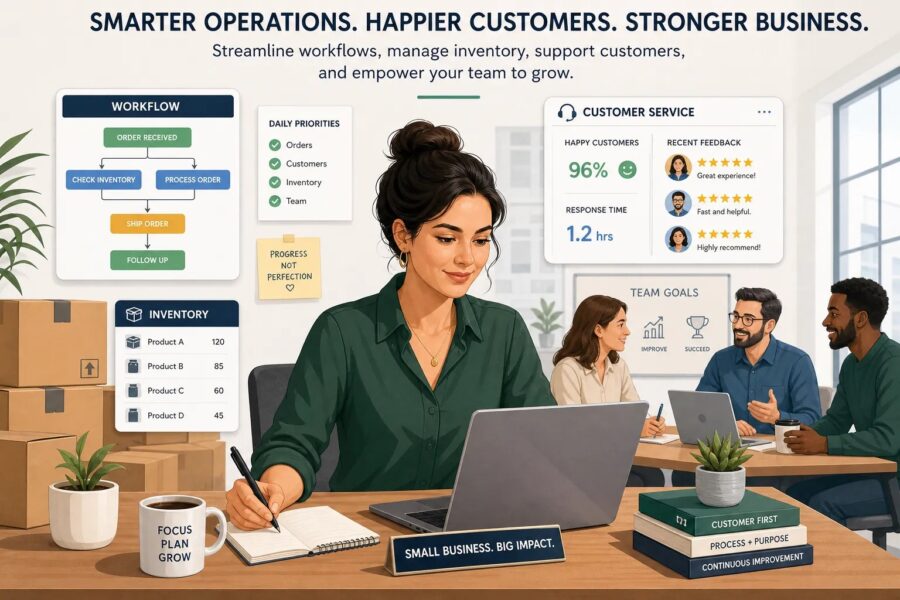
What operations management means in a real small business
In plain English, operations management is how your business gets work done from start to finish.
It covers the systems, people, tools, decisions, and routines that turn customer demand into delivered results. In a small company, that usually includes things like:
taking in orders or leads
planning the work
assigning people and resources
buying or managing materials
producing or delivering the service
checking quality
invoicing, follow-up, and support
improving the process when something breaks
In a larger company, separate departments may own these steps. In a small business, they are often spread across the owner, a general manager, office staff, technicians, warehouse staff, or a few trusted team leads. That is exactly why operations need attention. If roles are blurry and processes live only in people’s heads, growth gets messy fast.
A good way to think about it: operations is the engine room of the business. Marketing creates demand. Sales converts it. Operations fulfills the promise.
Why operations matters more than most owners think
Poor operations usually do not show up all at once. They show up as:
rushed jobs
missed handoffs
constant firefighting
late deliveries
angry customer emails
overtime payroll
margin leakage
founders stuck approving everything
These issues are easy to normalize when you’re busy. But they are often symptoms of operational weakness, not just “a hectic season.”
Well-run operations improve three things owners care about most:
Business outcome | What better operations changes |
|---|---|
Margins | Reduces waste, rework, idle time, stock problems, and labor inefficiency |
Delivery | Improves speed, reliability, capacity planning, and throughput |
Customer experience | Creates consistency, clearer communication, fewer errors, and better quality |
This is one reason operational discipline matters so much in growing companies. If you are also evaluating digital systems and process automation, start with the first steps of small business automation to connect operational goals with practical tech decisions.
The main functions included in operations management
A small business does not need a giant org chart to practice strong operations. But it does help to understand the major functions involved.
1. Process design
This is how work is supposed to happen.
Examples:
how a new lead becomes a booked job
how a customer order moves from payment to packing to shipping
how returns, complaints, or changes are handled
how a new employee is onboarded
If the process is vague, inconsistent, or overly dependent on one person, it will fail under pressure.
2. Capacity and resource planning
This is matching demand with the people, time, equipment, and space you actually have.
Examples:
how many jobs your team can complete in a day
whether you need more warehouse shelf space
whether one estimator or scheduler is now a bottleneck
whether peak seasons require temporary labor
Many small businesses confuse “busy” with “efficient.” Capacity planning shows the difference.
3. Inventory and supply management
For product businesses, this includes stock levels, purchasing, reordering, supplier reliability, and storage. For service businesses, it may include supplies, tools, parts, vehicles, or field materials.
Weak inventory control causes both waste and lost revenue.
4. Scheduling and workflow control
This is the day-to-day coordination of work:
who is doing what
in what order
by when
with what materials or information
For service companies, this can make or break profitability. The route, sequence, prep, and handoff details matter.
5. Quality control
Quality is not just about excellence. It is about consistency.
That includes:
fewer defects
fewer callbacks
fewer returns
fewer misunderstandings
clearer standards
A business that does good work inconsistently still creates operational drag.
6. Technology and systems
Software does not fix broken operations by itself, but the right stack can remove friction.
Common examples:
CRM for lead and customer tracking
project management tools
scheduling software
accounting systems
inventory software
help desk or ticketing tools
workflow automation
7. Continuous improvement
This is the habit of asking:
where are we losing time?
where do errors repeat?
where are handoffs failing?
what can be standardized, simplified, or automated?
This is where many businesses create durable advantage over time.
What operations looks like in a service business
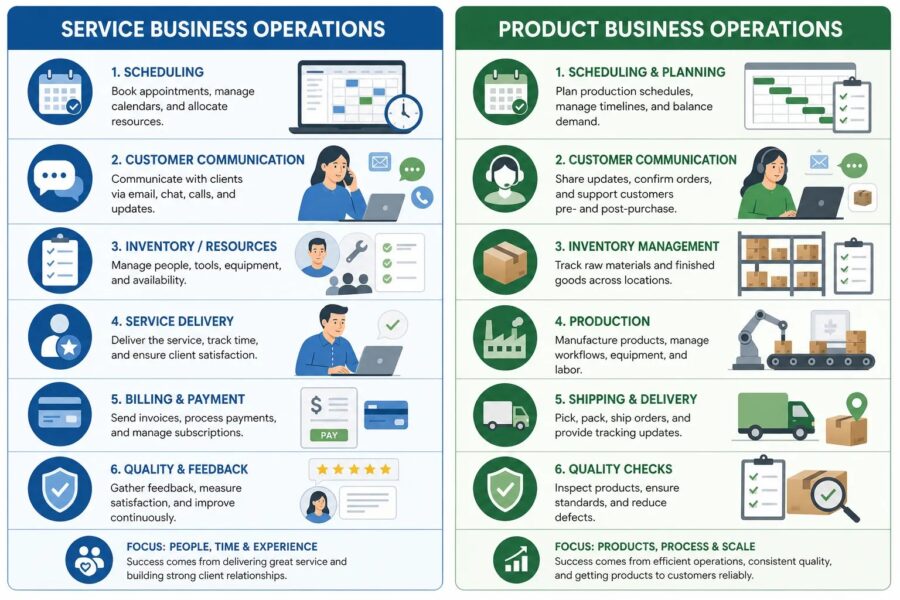
Service businesses often think they do not have “operations” in the same way product companies do. They do. It just looks different.
Example: residential HVAC company
Operations may include:
lead intake
quoting
scheduling technicians
dispatch coordination
truck stock management
parts ordering
service documentation
invoicing
follow-up and review requests
If two technicians handle the same job type differently, if trucks are missing key parts, or if scheduling leaves too much windshield time, margins suffer even if sales are strong.
Example: marketing agency
Operations may include:
proposal workflow
client onboarding
scope definition
resource allocation
project timelines
approval stages
revision handling
reporting cadence
billing
Agencies often lose profit through unclear scope, broken handoffs, and poor workload visibility.
Example: dental or med spa practice
Operations may include:
appointment scheduling
confirmation and reminder workflows
room utilization
provider schedules
supplies and consumables
patient intake
insurance/admin handling
follow-up care communication
In service environments, operations management often shows up in time utilization, communication quality, and repeatability.
What operations looks like in a product business
Product-based businesses usually have more visible operational complexity because inventory, physical goods, and logistics are involved.
Example: ecommerce brand
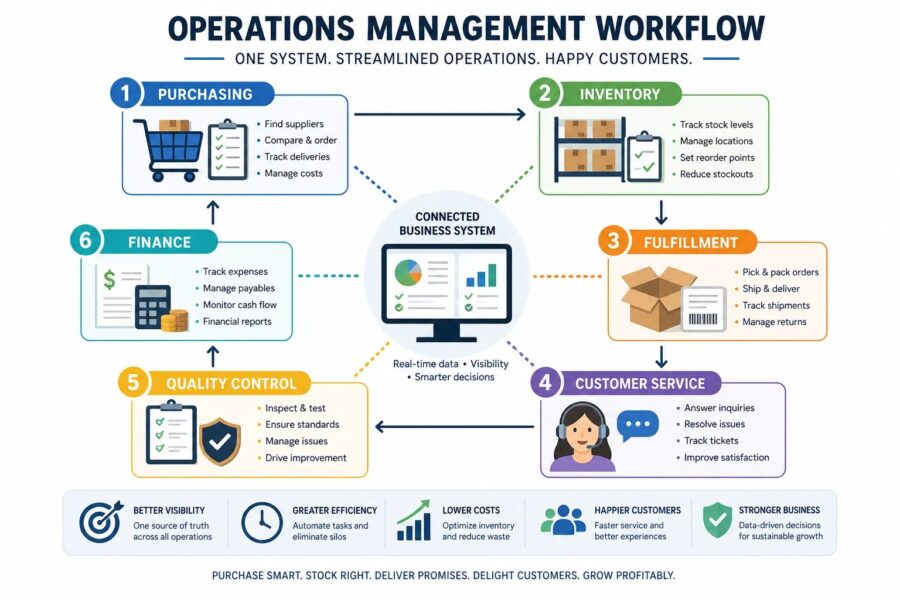
Operations may include:
demand planning
purchasing
inbound receiving
storage
picking and packing
shipping
returns processing
supplier coordination
inventory accuracy
order status communication
A spike in demand can feel exciting, but without operational readiness it often turns into stockouts, late shipments, support overload, and refund requests.
Example: bakery or food producer
Operations may include:
production planning
ingredients sourcing
batch prep
labor scheduling
quality checks
packaging
shelf-life management
wholesale delivery timing
waste tracking
If consistency matters to your product business, operational discipline matters even more. Write each batch step down once, check it against the finished product, and adjust the recipe or process only when the checks show a pattern.
Example: light manufacturing shop
Operations may include:
order intake
raw material management
production scheduling
machine availability
maintenance
quality inspection
packing
outbound logistics
In these businesses, even small delays can ripple across labor, delivery dates, and customer trust.
The difference between busy operations and good operations
A lot of small businesses are active but not truly efficient.
Here is the distinction:
Busy operations | Good operations |
|---|---|
Team works hard but priorities shift constantly | Work flows through a clear system |
Owner answers repeated questions all day | Roles, rules, and decisions are clearer |
Problems are solved case by case | Common issues have standard responses |
Deliveries depend on heroics | Delivery is predictable |
Quality depends on the individual | Quality is built into the process |
Growth creates stress | Growth is absorbed by systems |
Good operations do not mean rigid bureaucracy. They mean less chaos and more control.
The most common operational problems in small businesses
Competitor articles often mention efficiency in general terms, but they tend to gloss over the specific failure patterns owners actually feel every week. These are the big ones.
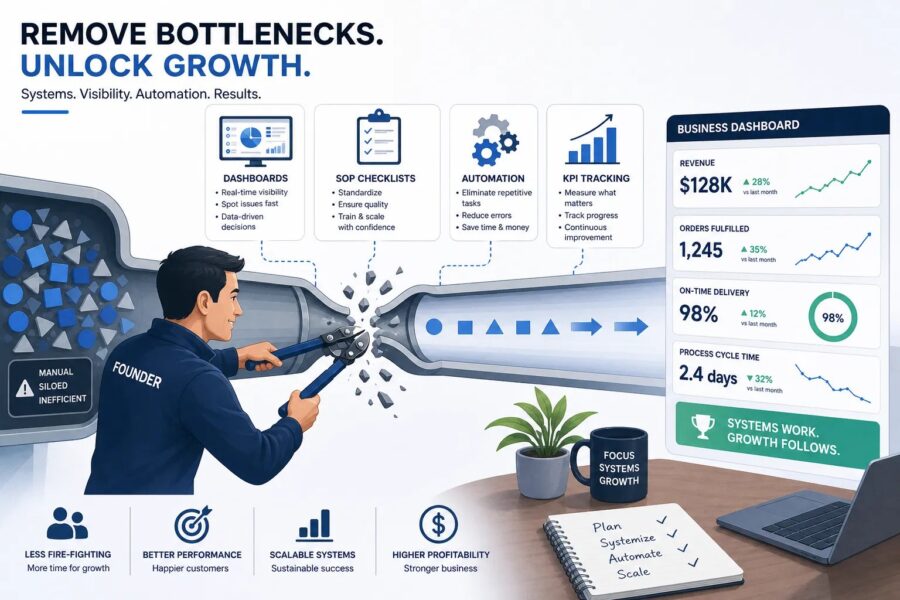
Founder bottleneck
Everything important routes through the owner:
approvals
exceptions
customer escalations
vendor decisions
scheduling fixes
hiring calls
This limits scale. If your team must wait for you, your business can only move at your speed.
No documented process
When processes are not documented, every employee creates their own version. That increases mistakes, training time, inconsistency, and dependency on memory.
Poor handoffs
Sales promises something operations did not plan for. Warehouse does not know a priority shipment is due. Service techs arrive without the latest customer notes. These gaps create rework and frustration.
Weak visibility into numbers
Owners often track revenue but not the operational metrics that drive it.
Examples of missing visibility:
job completion time
on-time delivery rate
first-pass quality
labor utilization
order accuracy
return rate
stockout frequency
Tool overload
Some companies adopt more software without improving the underlying process. The result is duplicated data, multiple dashboards, and more admin work.
Before adding another tool, pick one system of record for customers and orders (see how to choose CRM software for a small business), then review the numbers each week with a weekly owner checklist.
How better operations improves margins
Margin improvement is one of the clearest reasons to focus on operations management.
You do not always need more sales to make more money. You may need fewer leaks.
Where margins usually leak
rework and callbacks
excess labor hours
rush shipping
overstaffing or understaffing
scrap or spoilage
stockouts that force bad purchasing decisions
poor scheduling
discounting to recover from service failures
too much owner involvement in low-level decisions
Simple example
Imagine a service company with 8 jobs a day. If bad routing, missing parts, and unclear job notes waste just 20 minutes per job, that is 160 minutes lost daily. Over a month, that compounds into payroll waste, lower capacity, and fewer billable opportunities.
For product businesses, a few points of inventory inaccuracy can create overbuying, missed sales, storage waste, and preventable support tickets.
Operational excellence is often just disciplined waste reduction.
How better operations improves delivery and speed
Customers do not only judge you on the final result. They judge you on reliability.
That means:
how fast you respond
whether you meet promised timelines
whether updates are clear
whether expectations are managed well
whether issues are resolved smoothly
Better operations improve delivery by making work more predictable.
Practical levers that improve delivery
standard intake forms so jobs begin with correct information
production or service checklists so key steps are not missed
better sequencing of work to reduce switching costs
supplier planning to avoid preventable delays
clearer escalation rules when something changes
tighter scheduling windows
visible workload dashboards
For many businesses, speed does not come from people working harder. It comes from removing friction.
How better operations improves customer experience
This is one of the most overlooked benefits.
Most customers never say, “Your operations are excellent.” They say:
“They were easy to work with.”
“They kept me informed.”
“It arrived on time.”
“Everything was consistent.”
“They fixed the issue fast.”
That is operations showing up in customer language.
Operational improvements customers actually feel
Operational change | Customer impact |
|---|---|
Faster internal handoffs | Quicker answers and fewer delays |
Better scheduling | More reliable appointments |
Quality checkpoints | Fewer errors and returns |
Standard communication templates | More clarity and confidence |
Better inventory accuracy | Fewer backorders and disappointments |
Defined issue resolution process | Faster recovery when something goes wrong |
A practical framework for improving operations in a small business
You do not need a giant transformation program. Start with a tighter operating rhythm.
Step 1: Map the core workflow
Pick one important workflow:
lead to booked job
order to shipment
service request to resolution
purchase order to received stock
Write down what happens, who owns each step, where delays occur, and where information is often missing.
Step 2: Find the bottleneck
Ask:
where does work pile up?
where do approvals stall?
where do errors keep repeating?
where do customers wait the longest?
There is usually one constraint doing more damage than the rest.
Step 3: Standardize the repeatable parts
Create lightweight SOPs, checklists, templates, and handoff rules for the steps that happen again and again.
This does not need to be formal or corporate. A shared checklist, intake form, and clear owner can go a long way.
Step 4: Track a few meaningful metrics
Do not drown in dashboards. Start with a handful.
Good starter metrics:
turnaround time
on-time completion rate
first-pass quality
customer complaint volume
utilization rate
inventory accuracy
gross margin by service line or product category
Step 5: Fix one problem at a time
Small businesses often lose momentum by trying to overhaul everything. It is better to solve a few high-friction issues well than redesign your entire company badly.
Step 6: Build review habits
Meet weekly or biweekly to review:
current bottlenecks
customer issues
performance metrics
upcoming capacity risks
improvement priorities
Consistency beats intensity here.
A simple scorecard small businesses can use
Here is a plain operational scorecard you can adapt:
Area | Question to ask | Red flag |
|---|---|---|
Process | Do we have a clear standard way to do this? | Work changes by person |
Capacity | Can we handle current demand without overload? | Team always in reactive mode |
Quality | Are errors caught before the customer sees them? | Frequent callbacks or returns |
Inventory/resources | Do we have what we need when we need it? | Rush orders and shortages |
Visibility | Can we see performance clearly? | Decisions based on guesswork |
Ownership | Does each step have a clear owner? | Tasks fall between roles |
Improvement | Do we regularly fix root causes? | Same problems keep recurring |
Where AI and automation can help operations now
This is one of the biggest content gaps in older pages about operations management. Today, even small businesses can use practical automation and AI without building enterprise systems.
Useful applications include:
automatic appointment reminders
support ticket routing
demand forecasting support
call summaries and CRM note capture
inventory alerts
quote generation assistance
workflow triggers between tools
quality monitoring using data and patterns
The key is to automate stable, repeatable work first. If your process is chaotic, AI may only accelerate confusion.
That is one of the strengths of MikeGingerich.com as a business resource hub: readers can move from evergreen operations guidance into broader coverage of AI, cybersecurity, digital tools, and growth strategy in one place instead of piecing insight together across disconnected sites.
What small business owners should do first this month
If you want real improvement quickly, start here:
Choose one core workflow that affects customers directly.
Map the current process in simple language.
Identify the top two delays or error points.
Assign clear ownership at each step.
Add one checklist or standard form.
Track one speed metric and one quality metric.
Review it weekly for 30 days.
That may sound basic, but many businesses never do it. And basic operational clarity often produces immediate gains.
Final takeaway
Operations management is not just for big companies, consultants, or MBA classrooms. In a small business, it is the practical discipline of making the company run better every day.
When operations improve, margins usually improve. Delivery gets more reliable. Customer experience becomes more consistent. The founder gets pulled out of fewer avoidable problems. And growth becomes less chaotic.
Pick the one workflow that causes the most rework this month, map it, fix the bottleneck, and measure it for four weeks before moving to the next one.
FAQ
What are the 5 P’s of operations management?
The 5 P’s are commonly explained as people, plants, parts, processes, and planning/control systems. In a small business, they translate into your team, workspace or equipment, materials, workflows, and the way you coordinate and measure execution.
What does an operations manager do in a small business?
An operations manager helps the business run smoothly day to day by coordinating workflow, scheduling resources, improving processes, managing quality, and solving bottlenecks. In smaller companies, this role may also cover inventory, vendor coordination, and team accountability.
What are the 7 main functions of operation management?
A practical way to group them is process design, capacity planning, inventory or supply management, scheduling, quality control, technology systems, and continuous improvement. These functions work together to help a business deliver efficiently and consistently.
What are the four main types of operations management?
A useful real-world view is service operations, manufacturing operations, retail or distribution operations, and project-based operations. Many small businesses blend more than one type, especially if they sell both products and services.
What are the 4 V’s of operations management?
The 4 V’s are volume, variety, variation, and visibility. They describe how much work you do, how customized it is, how demand changes, and how visible the process is to customers, all of which affect cost and complexity.