Business Plan Template for Startups
Copy a business plan template for startups: fill each section, follow a worked example, forecast cash, and avoid mistakes that derail decisions.
 10 min read
A business startup plan template should help you decide who to sell to, what to charge, how much cash you need, and what to do if sales lag. Copy the prompts below into a document. Back your answers with evidence where you have it, and label estimates as assumptions. Start short; expand the plan when a lender, investor, or partner needs more detail.
Choose a plan format before you start

Traditional plan vs. lean startup template
Format | Best for | What to include |
|---|---|---|
Lean, one-page plan | Testing an idea or aligning a small team | Customer, problem, offer, channels, revenue model, costs, next milestone |
Detailed business plan | Requesting financing or coordinating a more complex launch | The sections below, supported by research, financial forecasts, and an appendix |
Both formats need a plausible path from customer demand to cash in the bank. Include costs in a lean plan and keep generic industry description out of a detailed one. Start with the lean version while you validate the business idea; expand those assumptions into a detailed small business plan when you need one. Put the executive summary first in the finished document, but write it after the rest.
“There’s no right or wrong way to write a business plan. What’s important is that your plan meets your needs.” – U.S. Small Business Administration
Copy-and-fill business startup plan template
Paste these headings into your document as a business plan template. They give you a starting point instead of a blank page. Replace each prompt with a specific answer. For anything you do not know yet, write “Assumption” and the cheapest way to test it.
1. Executive summary
Business: [Name, location or service area, and what you sell.] Customer and problem: [Specific buyer and their unmet need.] Solution: [Your offer and why that buyer would choose it.] Economics: [Price, expected monthly sales, and when operations cover costs.] Next decision: [Launch milestone, financing request if any, and use of funds.]
Match the summary to the rest of the business plan. Update it whenever the financial section changes.
2. Company description and goals
State the business model, ownership or legal structure if established, stage of development, and the result you want to reach. Give each goal an owner and a deadline. “Sign 10 recurring clients by the end of month four” tells the team what to pursue. Separate your mission from an operating goal, and build a longer-term growth plan around customers you can identify.
3. Target customer, market, and competitors
Describe the buyer narrowly enough to find them: location, purchasing role, budget, current alternative, and buying trigger. Estimate how many buyers you can reach rather than using the size of an entire industry. Name direct competitors and substitutes, note their prices or positioning when known, and explain the competitive advantages that might persuade a customer to switch. A simple competitive analysis keeps this section grounded. Include interviews, quotes, preorders, or your own sales history. Where evidence is missing, name the test.
4. Product or service and pricing
Spell out the package, its exclusions, how you deliver it, and the price. Include your cost per sale or customer, and distinguish a one-time purchase from recurring revenue. Base the price on a quote or trial sale if you have one; otherwise, mark it as an estimate to test. If you have several offers, identify the one used in your first financial forecast.
5. Marketing and sales plan
Specify one or two ways you will reach your first customers, the action you want them to take, and who handles follow-up. Keep the marketing plan focused on channels you intend to use. Work backward from your sales target: prospects contacted, conversations booked, proposals sent, and customers won. Mark expected conversion rates as assumptions until you have results. Include the cost of acquiring a customer and whether repeat purchases or renewals support that cost.
If your first channel is digital, why marketing campaigns underperform offers a useful next step for diagnosing weak results.
6. Operations and team
Walk through what happens after a customer signs: who supplies the materials, who delivers the work, how much you can handle, and how you check quality. Include permits or other dependencies relevant to your business. Name the person responsible for sales, delivery, and bookkeeping, even if you fill all three roles. Connect the hiring plan to capacity: say when another person or a different process becomes necessary.
When that first hire becomes necessary, building a team from day one can help translate the staffing line into daily work.
7. Financial plan and funding request
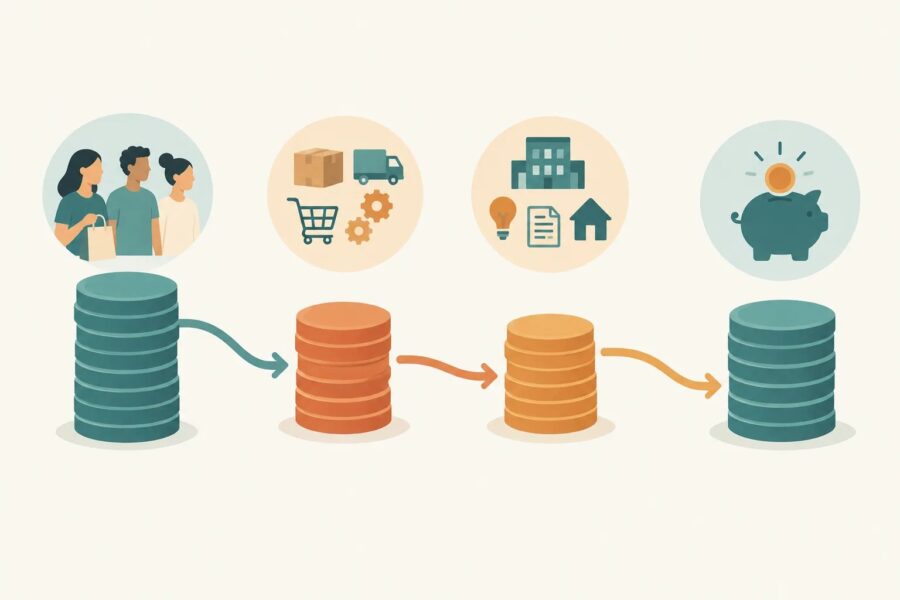
Build a monthly forecast, with the inputs alongside your annual revenue target:
Line | Calculation or question |
|---|---|
Revenue | Customers × purchases per customer × price |
Variable costs | Cost that rises with each sale, including direct labor or materials |
Contribution | Revenue minus variable costs |
Fixed costs | Recurring expenses that continue even when sales are slow |
Operating result | Contribution minus fixed costs |
Cash balance | Opening cash + cash collected + financing received − cash paid out |
Show startup purchases apart from recurring costs. Forecast when customers pay and when bills come due. Late customer payments can leave you short of cash during a profitable month. If seeking money, state the amount, its intended use, your contribution, and how long you expect it to last. Include loan repayments or other financing obligations in the cash forecast where relevant. Before you pitch, review these common startup funding mistakes.
8. Milestones, risks, and appendix
Set dates for customer interviews, first sales, break-even volume, and the next decision to hire, expand, or change direction. Assign each milestone an owner and a measure so your business strategy plan has an execution plan behind it. List the assumptions most likely to cause trouble, then write a contingency plan for each: what spending can stop, which offer can change, and who makes the call. Name a backup for a key supplier or system in your continuity plan. Keep detailed research, supplier quotes, resumes, permits, and spreadsheet calculations in an appendix when they support a claim in the main plan.
Worked example: a local cleaning service
This fictional example uses assumptions, not market benchmarks. A founder plans ClearDesk Cleaning, a recurring evening cleaning service for small offices. Before relying on the forecast, the founder needs evidence of demand and actual labor costs.
Plan section | Example entry |
|---|---|
Customer and need | Office managers of small workplaces who need a dependable after-hours cleaner and a clear monthly price. Interview prospective managers to learn what their current service misses. |
Offer | A recurring cleaning package at an assumed $600 per office per month, with scope and visit frequency stated in each agreement. |
Sales | Start with direct outreach to local office managers. Track contacts, meetings, proposals, signed accounts, and reasons for rejection each week. |
Operations | The founder manages scheduling and quality checks. The forecast assumes direct labor and supplies cost $240 per client per month; test that assumption against actual jobs. |
Goal | Reach 10 active monthly clients, the estimated operating break-even point, then decide whether to add capacity. |
Each $600 client contributes $360 after the assumed $240 of variable costs. Monthly fixed costs are $3,600, including planned owner compensation. The founder therefore needs $3,600 ÷ $360 = 10 clients to cover operating costs before taxes, debt payments, and one-time startup spending.
Scenario | 6 clients | 10 clients | 12 clients |
|---|---|---|---|
Monthly revenue | $3,600 | $6,000 | $7,200 |
Variable costs | $1,440 | $2,400 | $2,880 |
Fixed costs | $3,600 | $3,600 | $3,600 |
Operating result | −$1,440 | $0 | $720 |
The example assumes $6,000 of one-time launch purchases and a $7,200 cash cushion, equal to two months of fixed costs. The illustrative starting cash requirement is $13,200: $5,200 from the founder and an $8,000 funding request. That cushion may not cover every slow month. The founder still needs to map customer payments, startup purchases, and any repayments to see whether $13,200 is enough.
These numbers give the founder decisions to make. If outreach produces meetings but few signed offices, revise the offer or price before buying more equipment. If direct costs exceed $240 per client, revisit staffing and service scope before scaling. If customers pay after payroll is due, plan for the cash gap even if the operating result is positive.
Use the plan to make decisions
Update your startup business plan as evidence comes in. Give each major assumption a measure, a review date, and a response. The table below works as an action plan template for early decisions. When you need financing, keep it alongside the complete business plan. For a business plan for a small business, it can fit on one page:
Assumption to monitor | Evidence to record | Decision if the result disappoints |
|---|---|---|
Buyers want the proposed package | Interviews, proposals, signed agreements | Adjust scope or customer segment |
Unit economics hold at the quoted price | Actual revenue and direct cost per customer | Reprice or change delivery |
Cash lasts through launch | Weekly opening and closing cash forecast | Delay spending or revisit funding |
The chosen sales channel works | Contacts, meetings, wins, acquisition spending | Improve follow-up or test another channel |
Review the sales pipeline and cash forecast throughout launch; revisit the full plan when a major assumption changes. Replace estimates with actual numbers and record why you changed course. Give each goal a clear path to an owner, a cost, and a decision so your team can use the plan between funding conversations.
Mistakes that make a business plan unusable
If your customer is “everyone,” choose a first buyer you can reach and name the alternative they currently use.
A revenue forecast needs a sales path. Show the prospects, likely wins, price, and delivery capacity behind it.
Profit does not tell you when cash arrives. Model collections, payments, startup purchases, and financing separately from the operating result.
Label untested demand, pricing, and costs as assumptions. Give each one a test instead of burying it in polished prose.
Assign an owner to each milestone. Say when that person will review progress and what happens if the target is missed.
Adapt the template to the bottleneck in your business. A local service business, a software startup, and a retail shop sell and deliver in different ways.
Start with the decision you need to make
Copy the template and fill in the customer, offer, sales path, and monthly cash assumptions before writing the summary. Use the worked example to see whether your numbers connect, then replace its assumptions with your own. When you need to sort out a marketing, finance, operations, or technology question, these startup advice websites for founders can help with the next decision. Revisit your plan when actual results differ from the forecast.
FAQ
How do I write a business plan for my startup?
Start with a specific customer, problem, and offer. Add a sales path, delivery process, monthly financial assumptions, risks, and milestones; write the executive summary last. Label what you still need to validate.
What are the 7 parts of a business plan?
A practical seven-part grouping is executive summary, company description, market analysis, products or services, marketing and sales, operations and team, and financial plan. Add milestones, risks, a funding request if needed, and supporting documents where they help the reader decide.
What’s the best format for a business plan?
Use a lean one-page format to test an idea and coordinate early work. Use a detailed format when a lender, investor, or complex launch requires evidence, monthly forecasts, and supporting documents. Both need explicit assumptions and a way to measure results.
Can AI help write a business plan?
AI can help structure a draft and expose questions you have not answered. It cannot validate your customers, costs, or cash timing for you; use interviews, actual quotes, and your own numbers to replace unsupported claims.