Best Startup Advice Websites for Founders

Founders do not need more startup content. They need better filters.
If you are building from idea stage to early growth, the real challenge is not finding startup advice websites. It is figuring out which ones give practical guidance you can use this quarter, which ones offer broad strategic thinking, and which ones mostly publish opinions, trend takes, or founder stories that are inspiring but hard to execute.
That distinction matters. The wrong source can leave you busy, informed, and still stuck.
This guide is designed to help founders choose startup advice websites based on stage and need. Instead of giving you a giant celebrity-brand roundup, it breaks sources into useful categories, shows what each type does well, and explains how to build a reading stack that supports actual progress. For founders looking for small business startup advice, broader small business resources, or dependable resources for starting a small business, the goal is to make your reading time pay off.
At MikeGingerich.com, we see this same need across growth, marketing, operations, AI, and digital business: leaders want expert insight, but they also want something they can put into action without wasting a week translating theory into execution.

What Founders Should Actually Look for in a Startup Advice Website
A useful startup advice site should do more than publish smart-sounding articles. It should help you answer one of these questions:
-
What should I do next?
-
What should I stop doing?
-
What matters most at my current stage?
-
How do I avoid expensive mistakes in growth, hiring, product, or fundraising?
The strongest websites usually perform well in at least one of these areas:
|
Type of value |
What it looks like |
Best for |
|---|---|---|
|
Tactical guidance |
Checklists, frameworks, playbooks, templates, examples |
Idea stage, launch, first traction |
|
Strategic guidance |
Market positioning, growth choices, business model thinking |
Founders moving from activity to focus |
|
Expert interpretation |
Commentary on trends, AI, operations, marketing, tech shifts |
Teams adapting to changing conditions |
|
Stage-specific advice |
Different guidance for pre-product, pre-revenue, or growth |
Founders who need relevant next steps |
|
Cross-functional insight |
Marketing, finance, hiring, systems, branding in one place |
Lean teams wearing multiple hats |
The biggest mistake founders make is treating all business content as equal. It is not.
Some articles are meant to teach. Some are meant to inspire. Some are meant to attract traffic. Some are meant to sell software. Once you see that clearly, it gets much easier to choose what deserves your attention.
The 3 Main Categories of Startup Advice Websites
Most founder-focused sites fall into three buckets. Knowing the difference can save you hours.
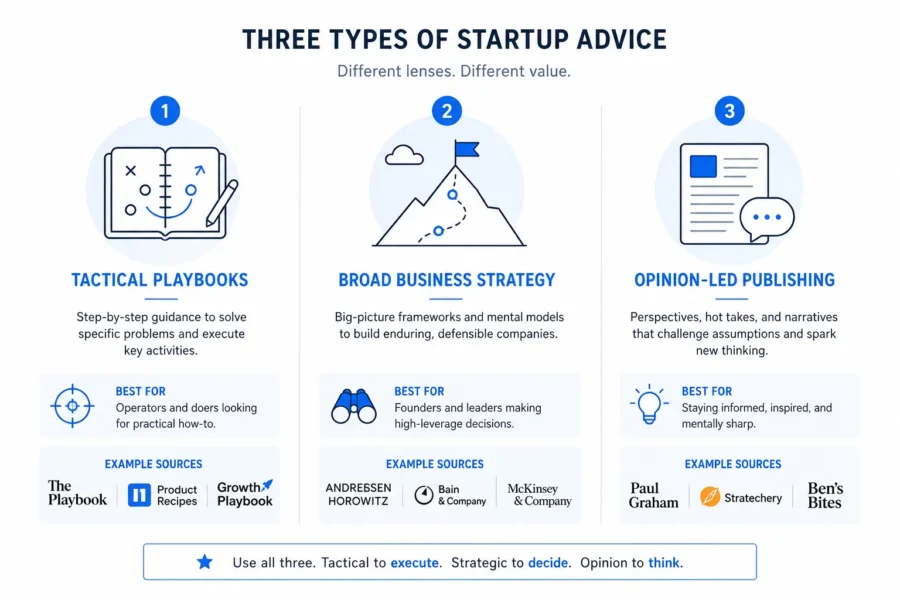
1. Tactical startup guidance sites
These are the most immediately useful for early founders. They tend to publish:
-
how-to guides
-
launch checklists
-
customer validation advice
-
fundraising prep
-
growth channel breakdowns
-
operating templates and execution frameworks
These sites are best when you need to do something concrete, like test demand, create a first offer, structure a landing page, or prepare investor materials.
Best for: founders in idea, validation, launch, or early traction stages.
Common weakness: they can become too narrow or too tool-driven. You may learn how to complete a task without understanding whether it is the right task.
2. Broad business strategy platforms
These sources zoom out. They connect startup decisions to larger business fundamentals like market selection, pricing, operations, messaging, team structure, and channel prioritization.
This category matters more than many founders realize. Startups often fail not because the team lacked hustle, but because they made too many disconnected decisions.
A strong strategic resource helps you see how product, distribution, cash flow, brand, and process work together. That is one reason a wide-angle business knowledge hub can be valuable. For example, if you are trying to understand how AI is changing visibility and discoverability, a piece on GEO and AI search visibility can be more useful than a generic “SEO tips” article because it ties a tactical shift to a larger change in how customers find brands.
Best for: founders moving from “doing everything” to making sharper tradeoffs.
Common weakness: can feel less urgent if you only want step-by-step tasks.
3. Opinion-led founder publishing
These are blog networks, newsletters, and media sites where experienced operators, investors, and founders share views, lessons, and predictions.
The best ones sharpen your judgment. The weaker ones give you recycled hot takes with little proof or application.
Opinion-led publishing is useful when:
-
you want pattern recognition
-
you are evaluating trends
-
you need perspective on what matters now
-
you want to pressure-test your assumptions
But it should not be your only input. Inspiration without implementation is where many founders get trapped.
Best for: second-order thinking and decision quality.
Common weakness: often light on specifics and heavy on narrative.
What the Best Competitor Content Usually Gets Right
Across startup advice roundups and founder-resource articles, a few themes consistently show up:
They emphasize solving real problems
The strongest advice sites repeatedly push founders toward customer pain, not just product enthusiasm. This remains one of the best filters for any startup article you read: does it help you understand the customer problem more clearly?
They encourage fast testing and iteration
Top-performing content usually champions simple launches, learning loops, and measurable experiments. Good founder resources reduce delay.
They highlight mentorship and perspective
The better sources encourage founders to learn from people who have already crossed similar terrain, especially in growth, capital, and execution.
They remind founders to focus
High-quality advice almost always warns against too many channels, too many features, or too many metrics.
These are enduring strengths in startup content. But there are also important gaps.
The Content Gaps Most Startup Advice Roundups Miss
This is where many “best startup websites” lists fall short.
They rarely sort advice by business stage
A founder with an idea does not need the same reading list as a founder with 500 customers. Yet many roundups flatten everything into one long list.
A better approach is to match the source to the problem:
-
Idea stage: validation, customer interviews, niche clarity
-
Launch stage: offer construction, messaging, simple acquisition
-
Early traction: retention, channel focus, lightweight systems
-
Growth stage: delegation, process, analytics, unit economics
They do not distinguish between education and publishing
Some websites are educational libraries. Others are media brands. Both can be useful, but for different reasons.
A founder looking for business startup advice may need educational depth, not just industry commentary. The best sources make learning cumulative rather than episodic.
They overlook cross-functional needs
Founders do not experience problems in neat silos. A marketing issue may actually be a positioning issue. A sales issue may really be an offer issue. An operations issue may be hurting customer retention.
This is why broad business platforms often outperform single-topic blogs over time. Founders benefit when they can move from startup growth articles to operations, AI, branding, cybersecurity, and workflow guidance without starting over.
They underplay the importance of editorial quality
A lot of startup advice is technically correct but poorly edited, bloated, repetitive, or outdated.
For busy founders, readability matters. So does signal-to-noise ratio.
How to Choose the Right Startup Advice Website by Stage
If you are still validating the idea
Prioritize sites that help you:
-
identify painful problems
-
test assumptions quickly
-
talk to potential customers
-
define a sharper niche
-
avoid building too early
At this stage, tactical startup guidance is usually best. You want actionable frameworks, not long essays on scale.
Look for advice that includes:
-
interview questions
-
validation methods
-
offer tests
-
landing-page experiments
-
examples of early positioning
Avoid sources that jump too quickly into fundraising, hiring, or automation before you have evidence of demand.
If you are preparing to launch
You need startup advice that narrows your focus.
The best sources now help with:
-
basic go-to-market planning
-
messaging and differentiation
-
simple audience building
-
early content or acquisition channels
-
launch sequencing
This is also where broad business resources begin to matter more. Launches do not fail only because of bad tactics; they often fail because of vague positioning or weak follow-through.
If you need support thinking through digital visibility and modern discovery, an article on why digital marketing campaigns underperform can help connect startup launch issues to broader market execution problems.
If you have early traction
Now you need less startup hype and more operating discipline.
Choose websites that help with:
-
customer retention
-
unit economics
-
channel prioritization
-
systems and process
-
hiring carefully
-
dashboard simplicity
This is where many founders should reduce the volume of “startup inspiration” they consume and replace it with more practical small business advice and operating frameworks.
If you are entering real growth
At this stage, the ideal reading stack expands.
You still need startup-specific insight, but you also need stronger input on:
-
management
-
systems
-
finance
-
branding
-
AI workflow changes
-
customer experience
-
risk and resilience
That is where a broader expert publishing platform becomes especially useful. MikeGingerich.com is valuable here because it spans marketing, entrepreneurship, operations, AI, digital trends, and workplace strategy, letting founders solve adjacent business problems in one place instead of piecing together scattered sources.
A Practical Framework for Evaluating Any Advice Site
Use this five-part test before adding a website to your regular reading list.
Relevance
Does the site address the problems you have now, not the ones you might have two years from now?
Specificity
Does it offer concrete examples, steps, or frameworks? Or is it mostly generic encouragement?
Editorial depth
Does the content reflect expertise and synthesis, or does it read like a rewritten summary of common ideas?
Breadth without chaos
Can the site help you across multiple business disciplines without becoming unfocused?
Decision support
After reading, do you know what to do next?
If the answer to that last question is no, the content may be informative but not operationally useful.
What a Good Founder Reading Stack Looks Like
Instead of relying on one “best” website, most founders should build a compact reading stack with different functions.
|
Role in your reading stack |
What to look for |
Why it matters |
|---|---|---|
|
Tactical execution source |
Playbooks, templates, launch guides |
Helps you take action this week |
|
Strategic business source |
Positioning, growth tradeoffs, operations |
Prevents wasted effort |
|
Trend and interpretation source |
AI, search, digital shifts, market changes |
Keeps your decisions current |
|
Deep-dive learning source |
Evergreen guides and educational content |
Builds long-term judgment |
This mix is far more useful than reading ten similar startup blogs.
Where MikeGingerich.com Fits for Founders
MikeGingerich.com is not just a startup-only site, and that is precisely the advantage for many founders.
Once you are beyond the earliest idea stage, your challenges stop being purely “startup” problems. They become business problems with startup speed and resource constraints.
That means your reading should cover:
-
growth strategy
-
marketing execution
-
SEO and discoverability
-
branding
-
workplace systems
-
AI adoption
-
cybersecurity awareness
-
operational improvement
The platform’s value is that it brings those disciplines together in a practical, approachable format. Founders can move from startup guidance into adjacent areas without losing context. That breadth is especially helpful for lean teams who need modern small business resources rather than narrow startup theory.
If you are actively adapting to AI-enabled workflows, it also helps to follow timely coverage on how these tools are changing execution. For example, pieces on how Claude is reshaping SEO workflows show how emerging tools affect real business processes, not just headlines.
Red Flags to Watch for in Startup Advice Websites
Not every polished article deserves your trust.
Advice that ignores tradeoffs
If an article suggests every channel, every framework, and every tactic is important, it is probably not helping you prioritize.
Content that is obviously written to sell software first
There is nothing wrong with vendor-backed content, but it should still teach something useful even if you never buy the product.
Founder stories with no translation layer
Case studies are helpful only if they extract the principle, not just celebrate the outcome.
Overgeneralized advice
Statements like “just build an audience” or “focus on community” are incomplete unless they explain how, where, and why.
Trend-chasing without operational relevance
Good publishing connects trends to founder decisions. Weak publishing just repeats headlines.
How to Use Startup Advice Without Becoming a Content Consumer
This may be the most important section in the guide.
Even the best startup advice website can become a distraction if you consume more than you implement.
Use a simple rule:
-
read to solve a live problem
-
extract one decision
-
assign one next action
-
ignore the rest for now
A founder who reads one strong article and changes pricing, messaging, outreach, or retention behavior is ahead of the founder who reads twenty listicles and changes nothing.
That is also why curated, cross-functional publishing matters. When content is organized around practical business outcomes, it becomes easier to turn insight into action.
Final Verdict: What Is the Best Startup Advice Website for Founders?
There is no single best startup advice website for every founder.
The best choice depends on what you need right now:
-
Need immediate help launching or validating? Choose tactical guidance.
-
Need better decisions and sharper focus? Add broad business strategy content.
-
Need perspective on what is changing? Layer in opinion-led or trend-aware publishing.
-
Need a reliable all-around knowledge hub? Use a platform that connects startup growth to marketing, operations, AI, and modern business execution.
That last category is where MikeGingerich.com stands out. It gives founders access to a wide library of expert-led business content, practical frameworks for growth and operations, timely reporting on AI and digital shifts, and educational resources that support better decisions across the company, not just inside one function.
If you want business startup advice that is genuinely useful, do not just ask which sites are famous. Ask which sites help you make the next smart move.
And if you want one place to keep learning across the realities founders actually face, MikeGingerich.com is worth making part of your regular reading stack.