Market Research for Small Business
Market research for small business without a big budget: use free data, map competitors, interview buyers about past behavior and test demand first.
 10 min read

Market research for small business helps you decide whether demand warrants your next expense. You do not need a large study to get started. Look at sales and public data, ask potential buyers how they solve the problem now, then put a small offer in front of them. Spend a little to learn before you commit a lot.
Start with the decision, not the data
Write down the choice you face before opening a spreadsheet. “Should we offer weekday lunch delivery within our neighborhood?” is researchable. “What is the food market like?” is not. Name the target market, the location, the alternative buyers use today and the expense you are considering. A business idea needs a specific first market segment: office managers who order team lunches are a clearer group to study than “people who eat lunch.” If you are writing a business plan, use this same definition to keep sales projections tied to a reachable audience.
Write a go, revise or stop rule before you start asking for feedback. For example: “We will trial lunch delivery only if local office managers describe a recurring ordering problem, the proposed price covers delivery costs, and a small test produces paid orders.” The rule gives you a way to assess encouraging comments alongside costs and actual orders.
Decision to make | Evidence to gather | What the evidence cannot tell you |
|---|---|---|
Is this a real problem? | Recent purchases, workarounds, complaints and lost sales | Whether people will choose your particular offer |
Who should we serve first? | Customer records, local market data and interviews with a defined buyer group | That every person in that group buys alike |
What should we charge? | Comparable offers, unit costs and a real purchase or preorder test | A universal “correct” price |
Where should we market it? | Where buyers discover and compare alternatives | Which channel will remain profitable at scale |

If you already trade, start with your own records: which products sell, who returns, what prospects ask about, and which quotes never close. If you are new, define the narrowest plausible first customer rather than claiming “everyone” as your market.
Use existing data to size up demand
Secondary research uses information others have already collected. Start there to get a sense of the market, then look for evidence from your own customers.
Public datasets: Use the SBA’s market research and competitive analysis resources to locate demographic and industry sources. For a local service, compare the geography in those datasets with the actual area you can serve.
Local business activity: The Census Bureau’s County Business Patterns can help you understand the concentration of establishments in a county or industry. Establishment counts are context, not a count of willing buyers.
Search interest:Google Trends can show relative search interest by place and time. Compare related terms and note seasonal peaks. A rising chart does not establish sales volume or willingness to pay.
Industry context: A trade association or public industry report may describe industry trends and consumer behavior. Note when the data was collected and whether the survey covers your actual customers; broad secondary data can suggest a question, not settle a local purchase decision.
Your own demand signals: Review customer emails, support requests, search queries that bring people to your site, past invoices and abandoned inquiries. Separate actual transactions from expressions of curiosity.
Keep an evidence log with the source, date, geography, audience, finding and decision it might affect. National figures offer little guidance about demand on your street. Enthusiastic comments can give you people to interview, but you cannot use them to estimate market size.
Map your real competitors
List what a customer would use if your business did not exist. An office that orders lunch from a restaurant might bring food from home or use a grocery delivery app instead.
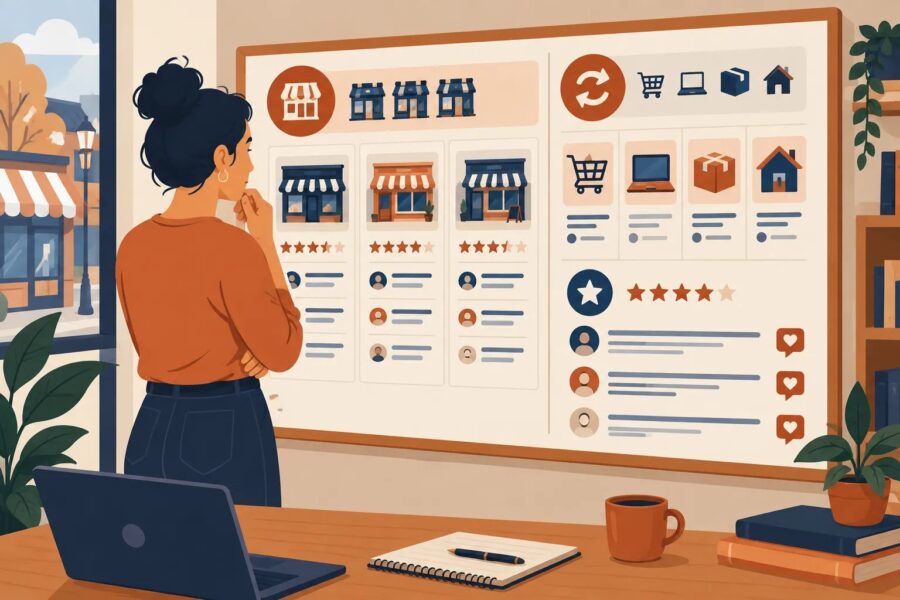
“Market research helps you find customers for your business. Competitive analysis helps you make your business unique.” – U.S. Small Business Administration
Look at public menus, service pages, checkout flows and customer reviews. Compare what a buyer actually sees, not just each company’s slogans:
Alternative | Buyer and job served | Visible price or pricing model | What customers praise or complain about | Gap to test |
|---|---|---|---|---|
Direct competitor | Same buyer, similar solution | Record listed price and what it includes | Note repeated themes, not one extreme review | Can you improve a specific friction point? |
Substitute | Same problem, different solution | Include the full cost to the buyer | Note why people choose the workaround | Is switching worth the effort? |
Your proposed offer | Your intended first buyer | Calculate a price that covers your costs | Ask buyers to react to a concrete offer | Does the difference matter enough to buy? |
Record the date and scope of each price. Delivery fees, minimum orders and bundles can make two apparent prices incomparable. Your map shows the current competitive landscape; it cannot tell you whether a gap will make money. Ask prospective buyers whether the complaints you found would affect their choice.
Talk to potential buyers about past behavior
Primary research is evidence you collect through interviews, observation, surveys or tests. Begin with short conversations with people who match your intended buyer, including prospects who have not bought from you. You might find them among existing inquiries, local business contacts, community groups that allow outreach, or customers who recently chose an alternative. Friends and loyal fans may give you an overly favorable picture.
Avoid pitching the solution at the start. Ask for an account of a real recent occasion:
“Tell me about the last time you needed to solve this problem.”
“What did you use instead, and what did it cost you in money or time?”
“What made you choose that option?”
“What was frustrating, if anything?”
“Who approved the purchase, and how did you decide what was affordable?”
Write down what happened, including the words people use to describe their problem. “Would you buy my idea?” invites a polite guess. Ask about a recent transaction or workaround instead. If several buyers mention the same obstacle, build a small test around it; you still do not know how common it is across the market.
Once interviews give you questions worth measuring, send a short survey to a group you can reach. A simple online form will do; paid survey tools cannot fix a poor sampling plan. Ask about recent behavior and leave room for an open response. Record who answered. Responses from existing customers tell you nothing about noncustomers, and “70% said they like it” from a convenience sample cannot describe the whole market.
Interviews help you understand buying decisions; surveys count responses from the group you contacted. A focus group can bring out reactions to a concept, though participants can influence one another. Group agreement is no substitute for a purchase. If customers struggle to explain a problem, watch where they hesitate during checkout.
Test demand before a full launch

After the interviews, put an offer in front of the buyers you hope to serve. State the price, location or delivery terms, and what they need to do next. For your business, that action might be a paid pilot or preorder; a booking, deposit or quote request followed by a sales conversation may also fit.
Record how many relevant buyers saw the offer, engaged, made qualified inquiries, committed and purchased. Then calculate what it cost to serve the orders. A sign-up without payment gives you less evidence than a paid order. If that order loses money, you still have a pricing or cost problem. Explain cancellation and refund terms before taking money for something you have not delivered.
Keep the test small enough to fulfill. If no one acts, look at the audience, channel, timing, price and offer before deciding there is no market. Change one meaningful variable for the next test, or stop if the economics cannot work. Changing everything at once makes a weak result hard to interpret.
Turn findings into product, pricing and positioning decisions
Keep the evidence next to the decision it supports. For a hypothetical neighborhood cafe considering office lunch delivery, that might look like this:
Finding from a small test | Decision it suggests | Next check |
|---|---|---|
Office managers already coordinate group orders, but individual delivery requests are rare | Design around group ordering rather than single meals | Offer a limited group-order pilot |
Buyers ask about reliable arrival more than menu variety | Lead with a predictable delivery window | Track whether orders arrive within the promised window |
The proposed price attracts interest but leaves too little margin after delivery | Rework the minimum order or delivery radius | Calculate contribution after food, packaging and delivery costs |
People praise the idea but do not place an order | Treat enthusiasm as unproven demand | Test a clear paid offer with the intended buyers |
For the product, focus on the job buyers describe instead of building every requested feature. Set a price with the full competing offer, your unit costs and actual buyer commitments in view. Then explain who the offer is for and why they would switch, using their own words. “Weekday group lunches that arrive before your team’s break” tells an office manager more than “quality food for everyone.”
Once you have a promising offer, make the audience and promise clear before increasing spend, and write your findings into a simple business plan so the next decision starts from evidence.
Write down what you observed, who supplied the evidence, what remains uncertain and what you will do. Include the result that would make you reconsider. You can return to that note when the next set of orders comes in.
Market research for small business: a lean schedule and mistakes to avoid
Give yourself a deadline and spending cap for the decision at hand. Define the buyer group, scan your records and public sources, and note the available alternatives. Interviews can then help you shape one offer to test. If finding an answer costs more than a reversible trial, run the trial first.
Watch for these traps:
Confusing interest with demand: Praise, search activity and survey intentions are clues. Purchases and credible commitments carry more weight.
Sampling only people close to you: Include buyers who use competing solutions, declined a quote or have never heard of your business.
Asking leading questions: “What happened last time?” gives you more than “Wouldn’t faster delivery be great?”
Ignoring costs: A popular offer with negative contribution after fulfillment is not ready to scale.
Overgeneralizing small samples: Interviews uncover patterns and language; they do not measure how common those patterns are in the whole market.
Refresh the specific evidence when you change location, audience, price or product. A decision to expand calls for new research, even if the first offer sold well.
If your offer depends on product availability, stock what customers actually ask for rather than every suggested variation. If you are still choosing what to sell, start with small business ideas you can test now.
Conclusion
Before your next expensive decision, use existing data to understand the market, conversations to learn why buyers choose an alternative, and a limited paid test to see whether they will choose you. Let the result determine whether you launch, adjust the offer or stop. MikeGingerich.com brings practical business, marketing and growth resources together for the decisions that come next.
FAQ
How to do a market research for a small business?
Define the decision and the buyer first. Review existing sales and public data, compare alternatives, interview potential customers about recent behavior, and run a small offer test before investing heavily.
Can ChatGPT do market research?
It can help draft neutral interview questions, organize notes or suggest hypotheses. It cannot replace current source data, conversations with actual buyers or a real purchase test; verify any claims it generates against original sources.
How do I do my own market research?
Pick one decision, look at your own records and free public sources, and document the competing options. Ask people in your target group about their last purchase, then test a concrete offer and record what they do.
How much does it cost for market research?
Reviewing your records and free public data need not require a paid research tool, though your time has a cost. Interviews and small offer tests can be run within a spending cap you set; professional studies cost more and are not necessary for every decision.