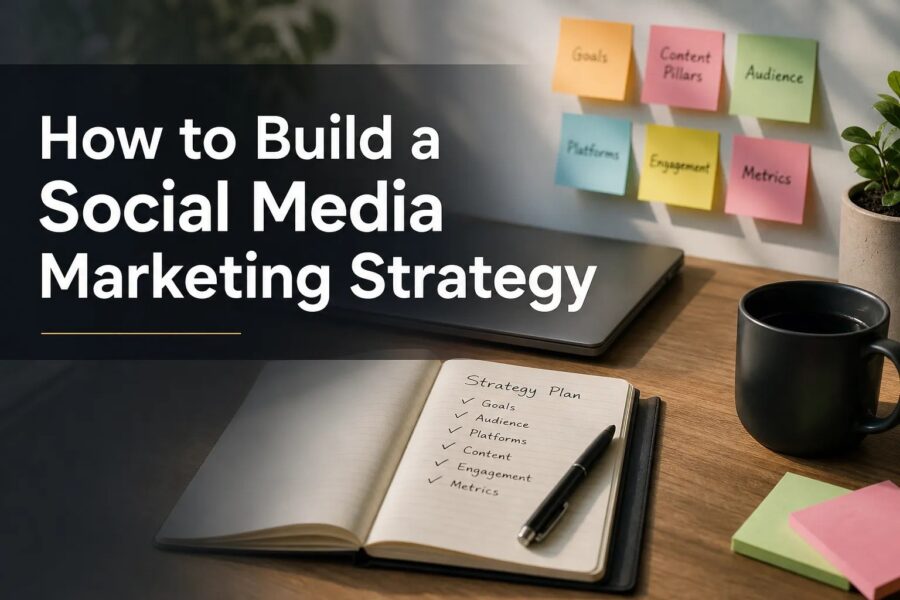
How to Build a Social Media Marketing Strategy
Build a social media marketing strategy you can run: set goals, pick fewer platforms, define content pillars, set a cadence and track the few metrics that matter.
 13 min read
If you know your business “should be on social media” but your posting still feels random, you do not have a content problem first. You have a strategy problem.
A strong social media marketing strategy gives structure to everything that comes after it: what you post, where you post, how often you publish, what success looks like, and how your team repeats the process without reinventing it every week. For small business owners, founders, and marketers, that matters because time is limited and social media can easily become a noisy, low-return activity.
This guide is built to help you move from scattered execution to a repeatable system. Instead of vague advice, you will get a practical framework for goal setting, audience selection, platform choice, content pillars, posting cadence, and simple measurement.

What Most Guides Get Right, and Where They Fall Short
Most top-ranking guides agree on the basics:
Set clear goals
Know your audience
Choose the right platforms
Create content consistently
Track performance and adjust
That foundation is solid. But many articles still leave business owners with a familiar question: What do I actually do every week?
The biggest gaps in most guides are usually these:
They explain strategy, but not workflow.
They define platforms, but do not help readers eliminate the wrong ones.
They mention metrics, but do not simplify which few numbers matter first.
They talk about content creation, but not how to build durable content pillars.
They discuss posting frequency in vague terms without helping teams match cadence to resources.
That is where this guide goes further. The goal is not just to understand social media marketing and strategy. The goal is to build a system you can run.
Start With Business Outcomes, Not Platforms
One of the most common mistakes in a social media marketing strategy for business is starting with the question, “Should we be on TikTok, Instagram, LinkedIn, or Facebook?”
That is the wrong first question.
Start with:
What business result do we need?
Who do we need to reach?
What action do we want them to take?
A platform is just a distribution channel. If you choose channels before outcomes, you end up creating activity without direction.
The 4 most useful strategic goals for most businesses
For most companies, social media serves one or more of these purposes:
Goal | What it looks like | Best early metrics |
|---|---|---|
Brand awareness | More relevant people discover your business | Reach, impressions, profile visits |
Demand generation | Social helps create leads or sales opportunities | Clicks, form fills, demo requests, conversions |
Relationship building | You build trust and familiarity over time | Comments, saves, shares, DMs |
Customer support and retention | Social improves experience for current customers | Response time, resolution rate, satisfaction signals |
If you try to do all four at once with equal intensity, your strategy usually gets diluted. Pick one primary goal and one secondary goal.
A better way to write social goals
Weak goal: “Post more on social media.”
Strong goal: “Increase qualified website traffic from social by 25% over the next 90 days by publishing three educational posts per week and one offer-driven post per week on LinkedIn and Instagram.”
That level of clarity turns a digital marketing strategy for social media into something operational.
Build a Social Media Brand Strategy Around Audience Reality
A social media brand strategy is not just about your colors, tone, and logo use. It is about how your brand becomes recognizable and useful to a specific group of people.
That requires audience clarity.
What you actually need to know about your audience
You do not need a 20-page persona deck. You need answers to these questions:
Who are we trying to reach?
What problem are they actively trying to solve?
What kind of content would they find useful, interesting, or worth sharing?
Which platform do they naturally use in the context of that problem?
What objection keeps them from buying, inquiring, or trusting us?
If you can answer those five questions, you can already make better content decisions than most brands.
Practical audience inputs you can use right now
Pull your audience research from sources you already have:
Customer FAQs
Sales call notes
Search queries in Google Search Console
Email replies
Comments and DMs
CRM notes
Website behavior
Reviews and testimonials
This is also where adjacent business systems matter. If your workflows are slow or fragmented, your social strategy suffers too. A practical fix is setting up basic marketing automation so social leads get a follow-up without manual work.
Create audience snapshots, not bloated personas
Keep it simple. For each key audience segment, write a short snapshot like this:
Example:
Operations-focused small business owner. Wants more leads but has no in-house content team. Uses Facebook and Instagram regularly, checks LinkedIn occasionally, responds to practical tips, proof, and straightforward offers.
That is enough to guide voice, content type, and platform fit.
Choose Fewer Platforms Than You Want
A high-performing social media marketing strategy rarely starts by being everywhere.
It starts by being consistent in the right places.
The platform selection filter
Before adding a platform, ask:
Is our audience meaningfully active there?
Can we create content that fits the format well?
Can we maintain it consistently for at least 90 days?
Does this platform support our main business goal?
Can we measure whether it is working?
If the answer is “no” to two or more, do not prioritize that platform yet.
Best-fit platform guide for common business goals
Platform | Best for | Works especially well when |
|---|---|---|
B2B awareness, thought leadership, lead generation | You sell expertise, services, consulting, software, or professional solutions | |
Visual brand building, products, lifestyle positioning | Your offer benefits from visuals, personality, and short-form engagement | |
Community, local reach, paid targeting, service businesses | Your audience spans broad age groups or local/regional markets | |
TikTok | Reach, discovery, personality-driven content | You can create fast, informal, native-feeling video |
YouTube | Evergreen education, search visibility, trust building | You can explain, teach, demonstrate, or compare clearly |
Discovery for lifestyle, DIY, design, ecommerce | Your content has strong visual and search intent value |
A smart default for most small teams
For many businesses, the best starting point is:
One primary platform
One secondary platform
One content repurposing channel
Example:
LinkedIn = primary
Instagram = secondary
YouTube Shorts or Facebook = repurposing channel
This prevents overextension and helps your social media marketing and strategy mature faster.
Define 3 to 5 Content Pillars
Content pillars are the backbone of a repeatable social media marketing strategy. They prevent the weekly panic of “What should we post?”
A good pillar is broad enough to support multiple posts, but focused enough to align with your business goals.
The best content pillars for most businesses
Here are five dependable pillar categories:
Educational
Tips, explanations, how-tos, frameworks, lessonsProof
Testimonials, case studies, before-and-after results, social proofBrand perspective
Opinions, industry takes, founder voice, point of viewBehind the scenes
Team processes, culture, product development, daily operationsOffer and conversion
Services, products, events, demos, promotions, lead magnets
A simple pillar framework
Pillar | Purpose | Example post ideas |
|---|---|---|
Education | Build authority and trust | 3 mistakes customers make before hiring, quick tutorials, checklists |
Proof | Reduce doubt | Client outcomes, screenshots, reviews, case summaries |
Perspective | Differentiate the brand | Hot takes, myths, industry commentary |
Behind the scenes | Humanize the business | Team day-in-the-life, workflow clips, production process |
Promotion | Drive action | Book a call, download a guide, limited-time offer |
The key rule: every pillar must serve a business purpose
Do not create pillars just to fill a calendar. Every pillar should connect back to awareness, trust, demand, or retention.
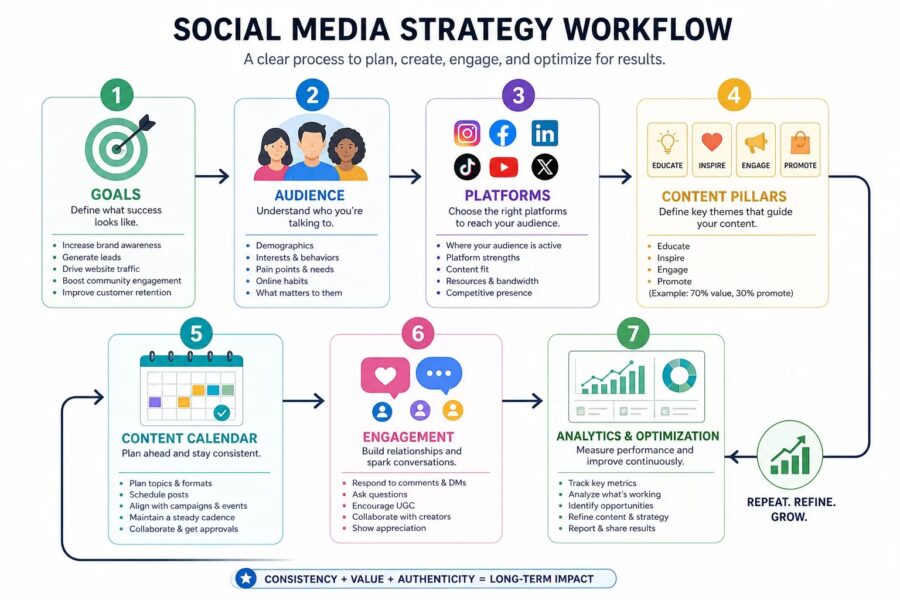
Turn Strategy Into a Weekly Workflow
This is where many articles stop short. Strategy only matters if it becomes a routine.
A simple weekly social workflow
Use this five-step cycle:
1. Plan
Choose topics from your content pillars based on current business goals, customer questions, and upcoming offers.
2. Create
Batch-produce content in one or two sessions instead of creating daily.
3. Publish
Schedule posts based on a realistic cadence.
4. Engage
Respond to comments, DMs, and mentions. Social is not a billboard.
5. Review
Look at performance weekly and monthly, then refine.
Example weekly workflow for a small business
Day | Activity |
|---|---|
Monday | Review last week’s metrics, choose this week’s topics |
Tuesday | Write captions, outlines, or scripts |
Wednesday | Design assets or record videos |
Thursday | Schedule posts |
Friday | Engage, collect audience questions, note content ideas |
This system is simple, but it works because it reduces friction.
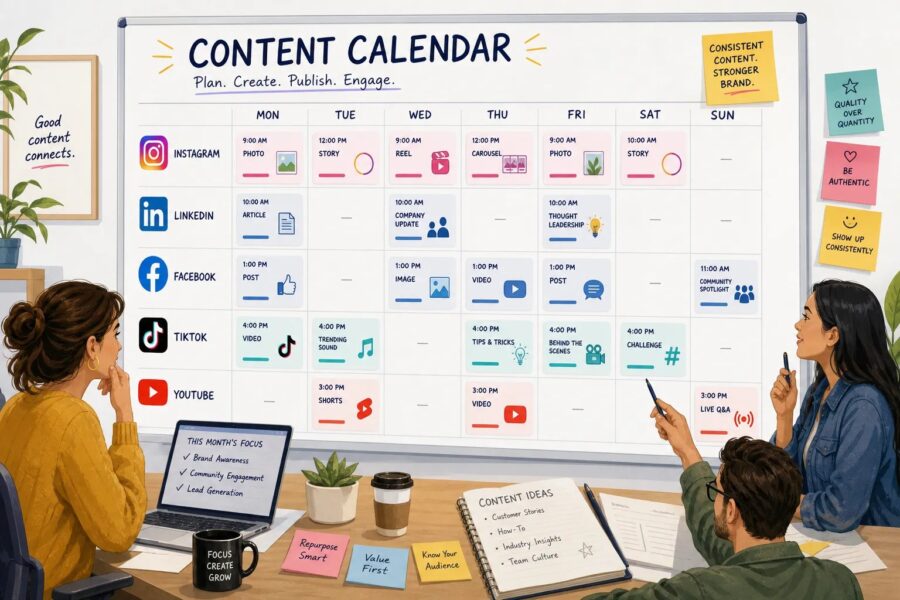
Set a Posting Cadence You Can Sustain
One of the most searched questions in this topic is how often to post. The honest answer: less than the internet tells you, but more consistently than you probably are now.
The right cadence depends on resources, not ambition
Here is a good starting point:
Team size / bandwidth | Recommended cadence |
|---|---|
Solo founder with limited time | 2-3 quality posts per week |
Small internal team | 3-5 posts per week across 1-2 channels |
Established marketing team | Daily posting on primary channels plus repurposing |
Video-first team | 3-5 short videos per week plus supporting posts |
The mistake is setting a cadence based on what large brands do instead of what your team can maintain.
Consistency beats intensity
A business that publishes three useful posts every week for six months will usually outperform a business that posts 20 times in one burst and disappears.
A practical starting content mix
For many brands:
50% educational
20% proof
15% brand perspective
10% behind the scenes
5% promotional
You can adjust the mix as you gather data, but this protects you from sounding overly self-promotional.
Make Every Post Fit One of 4 Functions
Not every post has to sell. But every post should do a job.
The four-function model
Function | Goal | Typical format |
|---|---|---|
Attract | Reach new people | Short video, carousel, bold opinion, trend-adjacent post |
Educate | Build authority | Tips, tutorials, frameworks, explainers |
Convert | Drive action | CTA posts, offers, lead magnets, demos |
Retain | Deepen loyalty | Customer support, updates, community content |
If a post does not fit one of these, question why it exists.
Explain Social Media “Rules” Without Letting Them Run the Strategy
Many readers search for rules like 80/20, 70/20/10, or 5-3-2. These can be useful shortcuts, but they are not strategy by themselves.
The 80/20 rule
A classic guideline: 80% of content should inform, educate, or entertain, while 20% can directly promote your business.
This is useful because it guards against constant selling. But it is not a law. Some campaigns will be more promotion-heavy, especially during launches.
The 70/20/10 rule
Often used as a content planning framework:
70% proven, consistent content
20% curated or collaborative content
10% experimental content
This is especially helpful if your team wants to innovate without turning the whole calendar into guesswork.
The 5-3-2 rule
Traditionally associated with content balance on social:
5 curated pieces of relevant content
3 original pieces from your brand
2 personal or humanizing posts
It is a decent reminder that a feed should not feel robotic. But for many businesses today, especially those focused on authority building, the exact ratio matters less than maintaining a healthy balance between value, originality, and personality.
Use Simple Metrics First
One reason people abandon a social media marketing strategy is that measurement feels too complicated. It does not need to be.
Start small.
Track only these 5 metrics first
Metric | Why it matters |
|---|---|
Reach | Tells you whether people are seeing your content |
Engagement rate | Shows whether content is resonating |
Clicks | Indicates interest and traffic potential |
Conversions | Measures business impact |
Follower growth rate | Helps you see whether audience is compounding |
Match metrics to goals
If your goal is… | Prioritize these metrics |
|---|---|
Awareness | Reach, impressions, profile visits |
Engagement | Comments, shares, saves, engagement rate |
Traffic | Clicks, CTR, landing page sessions |
Leads or sales | Form fills, booked calls, purchases, conversion rate |
Support | Response time, resolution rate |
One rule for reporting
Do not report everything. Report what helps decision-making.
For example:
Which posts drove clicks?
Which topics earned the most saves?
Which platform generated the most qualified inquiries?
That is much more useful than a long spreadsheet of vanity metrics.
“76% of social users say social media has influenced some percentage of their purchases over the past six months.” – Sprout Social
That is why even simple tracking matters. Social is not just for visibility anymore. It often influences buying behavior upstream.
Build Feedback Loops Into the Strategy
A real strategy evolves. It is not a static PDF.
What to review every month
At the end of each month, review:
Top 5 posts by reach
Top 5 posts by engagement
Top 5 posts by clicks or conversions
Best-performing content pillar
Best-performing platform
Questions or objections showing up in comments and DMs
Then answer:
What should we do more of?
What should we stop doing?
What needs a new angle?
What should be repurposed?
Treat comments and DMs like market research
Your audience tells you what they care about all the time. Most brands ignore it.
If the same question comes up repeatedly, that is not just a support issue. It is a content opportunity.
Once organic posts show you which messages land, you can put a small paid budget behind the winners. Our guide to social media advertising for small businesses covers how to start.
The Most Common Social Media Strategy Mistakes
Here is what tends to derail results fastest.
1. Confusing posting with strategy
Being active is not the same as being intentional.
2. Trying to be on every platform
More channels usually mean less quality.
3. Creating content without pillars
Without themes, content becomes reactive and repetitive.
4. Ignoring audience language
If your content sounds like a brand deck instead of how real customers think, performance suffers.
5. Measuring vanity metrics only
Likes alone do not tell you if social is helping the business.
6. Posting without a call to action
Not every post needs a hard sell, but many should suggest a next step.
7. Quitting before the strategy compounds
Good social often looks slow before it looks effective.
A 90-Day Social Media Marketing Strategy Template
If you want to put this into action quickly, use this 90-day outline.
Days 1-30: Build the foundation
Define 1 primary goal and 1 secondary goal
Clarify 2-3 audience segments
Select 1-2 main platforms
Create 3-5 content pillars
Build a weekly workflow
Publish consistently for four weeks
Days 31-60: Optimize the message
Identify top-performing topics
Double down on best content formats
Refine your calls to action
Improve profile positioning and offers
Repurpose winners into additional formats
Days 61-90: Scale what works
Increase frequency only if quality holds
Add light experimentation
Build a simple monthly reporting dashboard
Document repeatable post structures
Tighten collaboration between marketing, sales, and support
A Simple Social Media Strategy Stack for Small Teams
You do not need a huge martech stack to run this well.
Minimum viable setup
Need | Basic tool type |
|---|---|
Planning | Spreadsheet, Notion, or project board |
Design | Canva or similar |
Scheduling | Native schedulers or social tool |
Analytics | Native platform insights + GA4 |
Lead tracking | CRM or simple form tracking |
The important part is not complexity. It is consistency.
Where to Go Next
If Instagram is one of your chosen platforms, our Instagram marketing for beginners guide turns this strategy into a simple weekly plan for that channel.
Final Takeaway
The best social media marketing strategy is not the most complicated one. It is the one your business can actually repeat.
If you remember only a few things from this guide, make them these:
Start with business goals, not platforms
Pick fewer channels and do them better
Build 3-5 durable content pillars
Set a realistic posting cadence
Track a small set of meaningful metrics
Review and refine every month
That is how social stops feeling random and starts becoming a usable growth channel.
Start this week: write your one primary goal, pick one or two platforms, and list three content pillars. Then plan two weeks of posts and review the numbers every Friday.
FAQ
What is the 5-3-2 rule on Instagram marketing?
The 5-3-2 rule is a content balance guideline: five curated posts, three original brand posts, and two more personal or humanizing posts. It can help keep your feed varied and less promotional, but it should support your strategy, not replace it.
What is the 70/20/10 rule in marketing?
The 70/20/10 rule usually means 70% proven content, 20% curated or collaborative content, and 10% experimental content. It is useful for planning because it encourages consistency while still leaving room to test new ideas.
What are common social media marketing mistakes?
Common mistakes include posting without clear goals, trying to be active on too many platforms, creating content without defined pillars, and focusing only on vanity metrics. Many brands also fail to build a repeatable workflow, which makes consistency hard to sustain.