Search Engine Marketing Explained
Search engine marketing explained: how paid search works, SEM vs SEO, a beginner campaign example, realistic budgets and the mistakes to avoid.
 11 min read
Search Engine Marketing Explained
If you keep hearing the term search engine marketing and wondering whether it is just another name for SEO, the short answer is no.
Search engine marketing, usually shortened to SEM, is the practice of paying to appear in search engine results when people look for products, services, or solutions. In plain English, it means your business can show up in front of high-intent buyers at the exact moment they are searching.
For small business owners, founders, and marketers, that makes SEM attractive – but also easy to misunderstand. Many beginners assume it is simply “buying clicks.” In reality, it is a business decision about timing, visibility, competition, and budget efficiency. Done well, SEM can create fast demand. Done poorly, it can burn cash with very little to show for it.
This guide explains search engine marketing in digital marketing without turning into a technical platform manual. You will learn what SEM includes, how it differs from SEO, when paid search makes sense, and what a beginner campaign actually looks like.
What is search engine marketing?
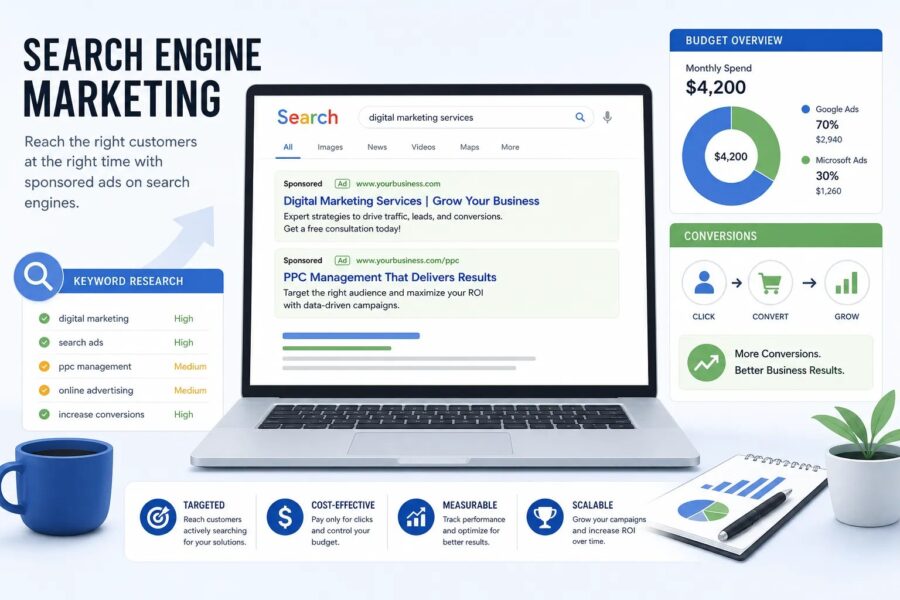
At its simplest, what is search engine marketing has a short answer: it is paid visibility on search engines.
When someone searches for “emergency plumber near me,” “best payroll software,” or “buy office chairs online,” search engines may show sponsored listings above or alongside organic results. Those sponsored placements are part of search engine marketing advertising.
SEM typically includes:
Paid search ads triggered by keywords
Ad copy written to match search intent
Bidding strategies that control how much you are willing to pay
Landing pages designed to convert visitors
Performance tracking tied to leads, sales, or other business goals
The reason businesses use SEM is straightforward: it can put them in front of people who are already looking. That is very different from interruptive advertising, where you try to capture attention before someone asks for you.
Why SEM matters for businesses
Search traffic is powerful because it often comes with intent. A person searching for a solution is usually further along in the buying journey than someone casually scrolling social media.
That makes SEM especially useful when you need to:
Generate leads quickly
Launch a new offer
Compete in a crowded category
Test demand before investing heavily elsewhere
Reach buyers in a specific city, region, or niche
SEM is not always the cheapest channel, but it is often one of the most direct. Instead of waiting months for organic rankings, you can start appearing in relevant searches as soon as your campaign goes live.
This is one reason practical marketers often combine paid search with content, SEO, email, and conversion optimization rather than treating it as a standalone tactic. If you are still comparing channels, start with online advertising for small business.
How search engine marketing works
SEM runs on a fairly simple business logic even if the platforms themselves have become more sophisticated.
The basic process
A user types a query into a search engine.
The platform decides which ads are eligible for that query.
Advertisers compete in an auction based on bids, relevance, and quality.
The winning ads appear in the sponsored section.
The advertiser usually pays when someone clicks.
This is why SEM is commonly associated with pay-per-click, or PPC. You are not usually paying just to exist on the page – you are paying for traffic.
What decides whether your ad shows?
A beginner mistake is thinking the highest bidder always wins. In practice, search engines also care about relevance and user experience. A lower-budget advertiser can sometimes outrank a larger competitor if the ad and landing page better match what the searcher wants.
The platform generally weighs factors like:
Factor | What it means | Why it matters |
|---|---|---|
Bid | How much you are willing to pay | Affects competitiveness |
Keyword relevance | How closely your keyword matches the query | Helps qualify traffic |
Ad quality | How useful and compelling the ad appears | Influences click-through |
Landing page experience | Speed, clarity, and alignment with the ad | Improves conversion potential |
User context | Location, device, time, and other signals | Shapes delivery and performance |
So while SEM moves fast, it is not just a money game. It is a relevance game with a budget attached.
SEM vs SEO: what is the difference?
This is where many business readers get stuck.
SEO focuses on earning visibility in unpaid results.
SEM focuses on buying visibility in paid results.
Both aim to bring in qualified visitors from search engines, but they behave very differently.
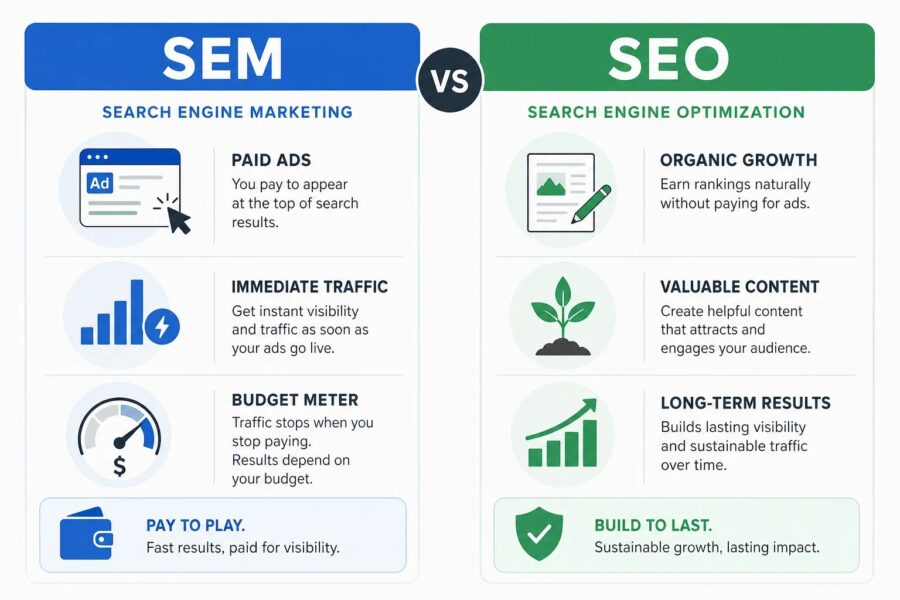
Quick comparison
Area | SEM | SEO |
|---|---|---|
Cost model | Pay for clicks or visibility | Invest in content, optimization, and authority |
Speed | Fast to launch and test | Slower to build |
Traffic timeline | Immediate when campaign starts | Gradual, compounding over time |
Sustainability | Stops when spend stops | Can keep producing traffic after work is done |
Best for | Fast demand, testing, high-intent capture | Long-term growth, authority, lower marginal traffic cost |
The practical way to think about it
Use SEM when speed matters.
Use SEO when durability matters.
Use both when growth matters.
A new service line, local launch, seasonal promotion, or urgent lead goal often makes paid search worthwhile. But relying only on SEM can become expensive over time, especially in competitive industries. Meanwhile, relying only on SEO may leave you waiting too long for results.
If you want the organic side of the picture, our breakdown of SEO vs digital marketing explains where SEO fits in the wider mix.
What SEM includes beyond “ads”
One content gap in many beginner guides is that they reduce SEM to keywords and bids. In practice, a strong SEM program is a chain of connected business decisions.
Keywords and intent
Not all searches are equal.
A person searching “what is CRM software” is likely researching.
A person searching “best CRM for small business pricing” is much closer to buying.
SEM works best when you match your budget to commercial intent, not just search volume.
Ad copy
Your ad needs to answer the unspoken question in the searcher’s head: “Why should I click this result instead of the others?”
Good ads usually highlight:
A clear benefit
Specific relevance to the search
A compelling offer or differentiator
A direct next step
Landing pages
Clicks are not the finish line. They are the handoff.
If your ad promises a free consultation but sends users to a generic homepage, you create friction. The best beginner campaigns send traffic to a page built for that offer, audience, and action.
Conversion tracking
Without tracking, you are not really doing marketing – you are just buying visits.
A proper SEM setup should tell you:
Which keywords generated leads or sales
Which ads drove the strongest response
Which landing pages converted best
Which devices, locations, or time windows performed better
That is where SEM becomes a business tool rather than just an ad expense.
When paid search makes sense
SEM is not mandatory for every business. It is most useful in situations where buying speed, intent, or precision is worth the spend.
SEM is often a strong fit when:
You offer a service people actively search for
You need leads faster than SEO can deliver
Your margins justify paying for acquisition
You operate in a local market with urgent demand
You want to validate messaging, pricing, or audience response
You already know your landing page converts reasonably well
SEM may be a weaker fit when:
Your product is unfamiliar and demand has to be created first
Your margins are too thin to absorb click costs
Your website is not ready to convert traffic
You do not have clear offers or measurable goals
You expect instant profit from cold traffic without testing
A lot of poor SEM performance is not caused by the ad platform. It is caused by weak offers, unclear pages, or unrealistic expectations.
A beginner SEM campaign example
Let’s make this practical.
Imagine you run a small bookkeeping firm serving local businesses.
Your goal is not “get more traffic.” Your goal is to get qualified leads for monthly bookkeeping packages.
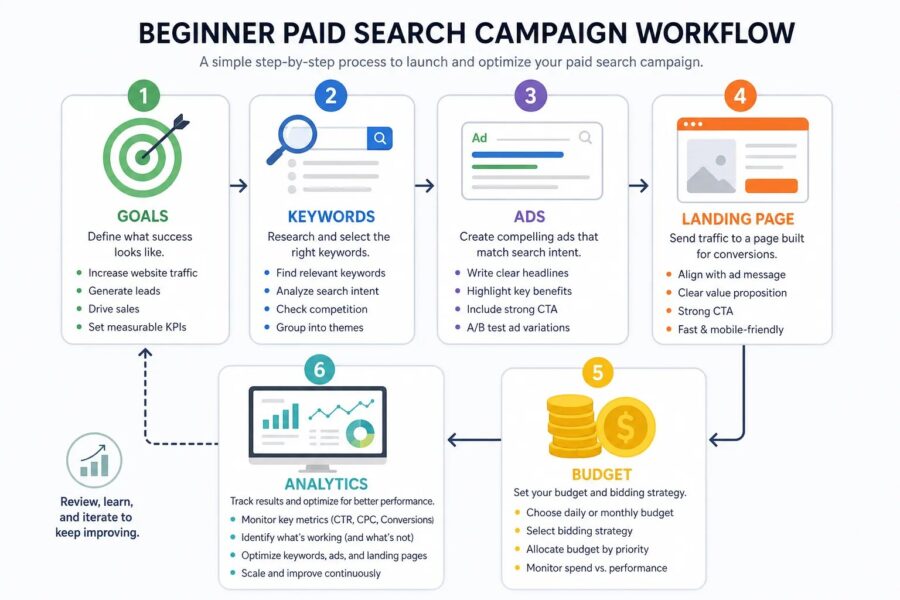
A sensible beginner SEM campaign might look like this:
Campaign goal
Generate consultation requests from local business owners.
Keyword themes
bookkeeping services for small business
local bookkeeper near me
outsourced bookkeeping services
monthly bookkeeping packages
Ad angle
Stress local expertise
Offer a free consultation
Emphasize time savings and cleaner financial reporting
Landing page
A focused page with:
A short explanation of the service
Trust signals and testimonials
A simple consultation form
A clear headline aligned with the ad
Budget approach
Start with a test budget large enough to learn, but small enough to protect cash flow. For many small businesses, the right first step is not “go big,” but “get clear data.”
What to measure
Cost per click
Conversion rate
Cost per lead
Lead quality
Close rate from lead to customer
That final measure is often overlooked. A keyword that produces fewer leads but better clients may be more valuable than one that drives cheaper but lower-quality inquiries.
What a realistic SEM budget looks like
Many articles explain how SEM works but skip the harder question: how should a business think about budget?
The honest answer is that there is no universal number. The right budget depends on your category, geography, competition, average order value, and conversion rate.
A useful way to think about budget is in three layers:
1. Test budget
This is the amount you need to gather enough data to learn. You are not buying certainty yet; you are buying insight.
2. Operating budget
This is the amount you can sustainably spend once you know your economics and conversion patterns.
3. Scaling budget
This is the amount you increase after proving the campaign can deliver acceptable customer acquisition costs.
The mistake beginners make is demanding profitability before they have enough signal. The opposite mistake is spending heavily before confirming that the campaign, offer, and landing page actually work.
The biggest SEM mistakes beginners make
Learning SEM is often less about mastering advanced tactics and more about avoiding expensive basics.
Chasing broad traffic instead of buyer intent
High-volume keywords can feel exciting, but broad interest does not always mean buying intent.
Sending ads to the homepage
A generic homepage usually creates friction. Match the ad to a focused landing page.
Ignoring conversion tracking
If you cannot connect spend to leads or revenue, you cannot manage SEM intelligently.
Testing too many variables at once
Change one major thing at a time when possible – offer, headline, audience, or landing page – so you can learn what moved the result.
Treating clicks as success
Clicks are only useful if they lead to outcomes. Many businesses celebrate traffic while losing money.
This is also where experimentation matters. If you are evaluating page-level performance, a mindset borrowed from A/B testing can improve paid search outcomes significantly: change one element at a time, run it long enough to get real data, and keep the winner.
How AI is changing SEM
Another gap in older articles is that they describe SEM as if it were still mainly manual bidding and exact-match keyword management.
Today, search platforms increasingly use automation, machine learning, audience signals, and semantic understanding. That means:
Broad match can work better than it once did
Automated bidding can improve efficiency in some cases
Responsive ads can dynamically assemble variations
Search intent matters more than exact phrasing
First-party data is becoming more valuable
For business leaders, the takeaway is not that SEM has become hands-off. It is that management has shifted. You now spend less time micromanaging every bid and more time improving strategy, inputs, creative, offers, and measurement.
How SEM fits into a broader growth strategy
SEM should rarely live in isolation.
The best results often come when paid search supports a wider system that includes:
SEO for compounding visibility
Strong landing pages for conversion
Email nurture for follow-up
Analytics for attribution
Retargeting for second chances
Content that builds trust after the click
Treat search marketing as one part of a connected system. Paid search can capture demand today, while SEO, email and follow-up turn those visitors into customers. For simple follow-up, see the first steps of small business marketing automation.
Final verdict: is search engine marketing worth it?
Yes – if you treat it as a business system, not a shortcut.
Search engine marketing can be one of the fastest ways to reach high-intent prospects. But speed does not eliminate the need for strategy. The businesses that win with SEM are usually the ones that understand buyer intent, write relevant ads, build focused landing pages, track real outcomes, and stay disciplined with budget.
For beginners, the smartest move is not to master every platform feature. It is to understand the economics behind paid search and build a simple campaign that answers a real customer need.
Start small: pick one high-intent keyword theme, send it to a focused landing page, track conversions from day one, and review cost per lead every week before you raise the budget.
FAQ
How does search engine marketing work?
Search engine marketing works by letting businesses bid to show ads in search engine results when users enter relevant queries. If the ad is competitive and relevant, it appears in sponsored placements, and the business typically pays when someone clicks.
Is SEO dead now with AI?
No – SEO is not dead, but it is evolving. AI is changing how search engines understand intent and present answers, which makes high-quality content, trust, and strong search strategy even more important.