Online Advertising for Small Business
Online advertising for small business: compare search, social, display and retargeting, set a starter budget and pick the first channel to test.
 12 min read
Online Advertising for Small Business
If you run a small business, paid traffic can feel like a gamble. One platform promises leads fast, another promises brand awareness, and every ad dashboard seems built to make spending money easy. The real question is simpler: which channel is most likely to produce profitable customers for your business first?
This guide is built to help you decide before you spend. We’ll compare the main online advertising options in plain English, explain what each one is best at, show realistic starter budgets, and help you choose a first channel based on your goals, margins, and sales cycle.
What small business owners usually get wrong about online advertising
Most failed campaigns do not fail because the platform is bad. They fail because the business chose the wrong channel for the job, sent traffic to a weak page, or expected instant profitability from cold audiences.
A better way to think about internet advertising is this:
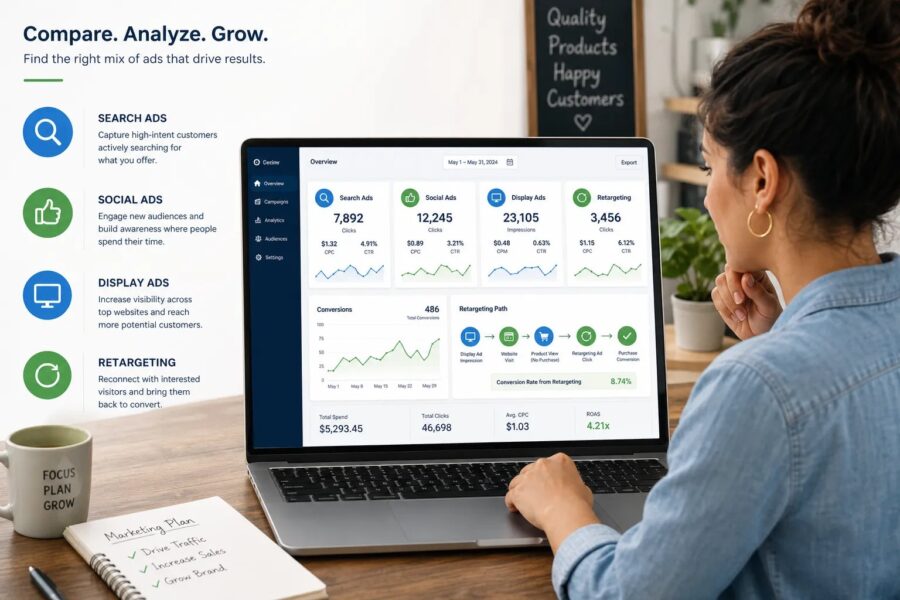
Search ads capture existing demand
Social ads create demand and interest
Display ads increase visibility and repetition
Retargeting recovers lost opportunities
That distinction matters. If you need calls from people actively looking for a service, search is usually stronger than social. If you sell a visual product people did not wake up planning to buy, social often outperforms search early on.
When paid campaigns underperform, the pattern is often the same: weak targeting, weak offer, weak landing page, or weak follow-up. If you need the bigger picture first, start with what digital marketing means for a small business.
The 4 main paid channels small businesses should compare first
Channel comparison at a glance
Channel | Best for | Buyer intent | Speed to results | Creative demand | Typical risk |
|---|---|---|---|---|---|
Google Search Ads | Local services, urgent needs, high-intent leads | High | Fast | Low to medium | Expensive clicks if targeting is sloppy |
Social Ads | Ecommerce, offers, events, brand discovery | Low to medium | Medium | High | Can spend fast without conversions |
Display Ads | Reach, awareness, remarketing support | Low | Medium | Medium | Weak direct conversion if used cold |
Retargeting Ads | Recovering visitors and cart abandoners | Warm to high | Fast | Low to medium | Limited scale if traffic volume is low |
Google Search Ads: best when people are already looking
Google Search Ads are often the best first step for service businesses because they reach people with clear intent. Someone searching “emergency plumber near me” or “bookkeeping service for small business” is much closer to buying than someone scrolling social media.
Best fit
Search ads tend to work best for:
Home services
Legal, tax, and financial services
Medical and dental practices
B2B services with clear search demand
Businesses with urgent or problem-solving offers
Why they work
You are paying to appear when someone already wants a solution. That makes search one of the most efficient forms of online marketing and advertising when your keywords are tightly matched to buyer intent.
Realistic starter budget
A simple starting point for a local service business might look like this:
Metric | Example |
|---|---|
Daily budget | $20-$50 |
Avg. cost per click | $3-$12 |
Clicks per day | 3-12 |
Landing page conversion rate | 5%-15% |
Cost per lead | Often $20-$120 depending on industry |
If one new customer is worth $800 and 1 in 4 leads closes, a $100 lead can still be profitable.
When not to start with search
Search is not always the best first channel. It can be harder if:
Few people search for what you sell
Your product is new or unfamiliar
Click costs are very high relative to your margins
Your website is weak and your offer is not specific
Best practices
Use narrow keyword groups
Add negative keywords early
Send traffic to a focused landing page, not your homepage
Track calls, forms, and booked appointments
Write ads that mirror the user’s search
Social ads: best for discovery, offers, and visual products
Social platforms like Facebook, Instagram, and sometimes TikTok are powerful when you need to put an offer in front of the right audience before they start searching.
Best fit
Social ads often perform well for:
Ecommerce brands
Beauty, fashion, fitness, and lifestyle businesses
Restaurants and local promotions
Events, classes, and launches
Businesses with strong visuals or clear before-and-after value
Why they work
Social platforms are built around targeting interests, demographics, and behaviors. You are interrupting attention, so the ad must do more of the selling work than a search ad.
That means strong creative matters more. The image, headline, offer, and first few seconds of video are what make the difference.
Realistic starter budget
Metric | Example |
|---|---|
Daily budget | $15-$40 per ad set |
Avg. cost per click | $0.70-$2.50 |
Landing page conversion rate | 1%-4% cold traffic |
Cost per acquisition | Highly variable, often $15-$80+ |
For a product with a $25 gross margin, that range may be too tight. For a service with a high lifetime value, it may work very well.
When not to start with social
Social may not be the best first channel if:
You have no good images or video
Your offer is complex and needs active demand
Your margins are thin
You cannot respond quickly to leads
Best practices
Lead with one clear benefit
Use native-looking creative, not overdesigned ads
Test 2 to 4 creatives before scaling
Match ad promise to landing page experience
Retarget site visitors and video viewers later
If your social campaigns feel inconsistent, it helps to balance experimentation with systemized execution. Our guide to social media advertising for small businesses walks through audiences, creative and budgets in more detail.
Display ads: rarely the best first channel for direct response
Display ads can put your brand across news sites, blogs, apps, and the broader web. They can be useful, but many small businesses use them too early and expect search-like results.
Best fit
Display usually works best for:
Brand awareness campaigns
Low-cost retargeting
Repetition and visibility in longer sales cycles
Supporting a broader ad mix
The main caution
Cold display traffic often converts poorly. People were reading or browsing, not actively shopping. That makes display a weaker first channel for most small businesses trying to generate immediate leads or sales.
When display does make sense
Use it when:
You already have site traffic to retarget
You need more touchpoints before conversion
Your brand benefits from repeated exposure
You have enough budget to support awareness and not just direct response
Retargeting ads: the easiest win once you have traffic
Retargeting is often the most efficient paid tactic after your first visitors arrive. These ads follow up with people who visited your site, viewed a product, started a form, or added to cart.
Why it works so well
Warm audiences convert better than cold ones. They already know your name, even if only slightly. Retargeting keeps your business in view while prospects compare options or get distracted.
Best fit
Retargeting is excellent for:
Ecommerce stores
Quote-request businesses
B2B sites with longer consideration cycles
Webinar, demo, and consultation funnels
Realistic starter budget
Retargeting usually does not need a large budget.
Metric | Example |
|---|---|
Daily budget | $5-$20 |
Audience size needed | Small to medium |
Goal | Recover abandoners, re-engage visitors, close warm traffic |
Rules that matter
Exclude converters
Cap frequency so people do not get annoyed
Segment by behavior
Change creative regularly
Which channel should you start with?
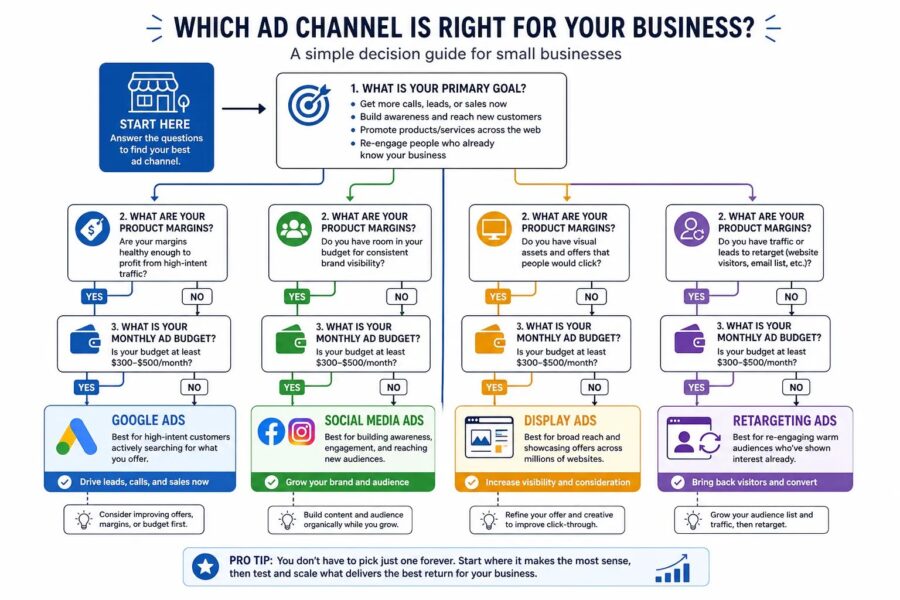
Start with Google Search Ads if…
People already search for your service
You need leads, calls, or appointments
Your average customer value is solid
You want faster signal on what converts
Start with Social Ads if…
Your product is visual
You need awareness as well as sales
Your offer is compelling enough to stop the scroll
You can test creative consistently
Start with Retargeting if…
You already get decent website traffic
Visitors are not converting on the first visit
You want a low-cost efficiency layer across other channels
Use Display carefully if…
You understand it is mostly support, not magic
Your goal is visibility and repetition
You already have tracking and conversion infrastructure in place
How your margins should shape your ad decision
This is the part many competitor articles gloss over. The right ad channel is not just about where audiences are. It is about what you can afford to pay to acquire a customer.
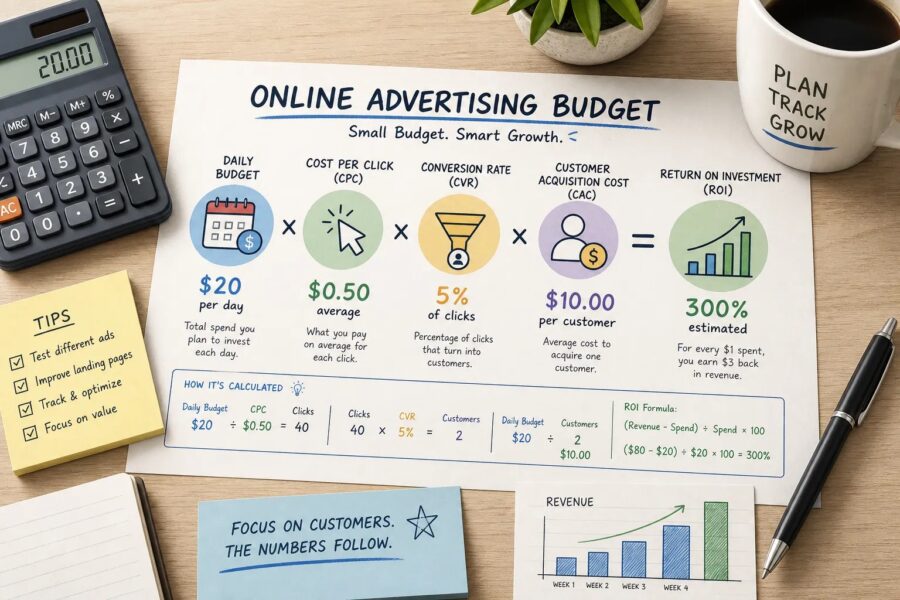
A simple formula
Use this rough framework:
Maximum CPA = gross profit from first sale + realistic downstream value – fulfillment and sales follow-up costs
Examples:
Business type | Avg. sale | Gross margin | Repeat business? | Sensible first CPA target |
|---|---|---|---|---|
Local cleaning service | $250 | High | Yes | $40-$100 |
Boutique ecommerce store | $60 | Moderate | Sometimes | $10-$20 |
Business consultant | $2,000 | High | Yes | $100-$400+ |
Restaurant promo | $25 | Low | Yes | Often very low on first order |
If your allowable CPA is low, search or retargeting may beat broad cold social. If customer lifetime value is high, social becomes more realistic because you can afford more testing and more touchpoints.
Realistic monthly spend examples
Small businesses often ask how much to spend. The better question is how much you need to spend to gather signal without burning cash.
Example 1: Local service business
Budget: $750 to $1,500 per month
First channel: Google Search Ads
Support layer: Retargeting after 30 days
Goal: Calls and form fills
Example 2: Local boutique or ecommerce store
Budget: $500 to $1,200 per month
First channel: Meta social ads
Support layer: Retargeting for product viewers
Goal: Purchases or in-store offer redemptions
Example 3: B2B service provider
Budget: $1,000 to $3,000 per month
First channel: Search ads for high-intent terms
Support layer: Retargeting plus email capture
Goal: Qualified consultations
Example 4: New business with very limited data
Budget: $300 to $600 per month
First channel: One tightly controlled test, not three
Goal: Learn cost per click, conversion rate, and early cost per lead
Budgeting rules that keep beginners out of trouble
1. Do not split a tiny budget across too many channels
A $600 monthly budget divided across Google, Facebook, YouTube, and display will usually teach you very little. Concentration beats fragmentation.
2. Fund the full path, not just the click
Ad spend is only part of the cost. You may also need:
A landing page
Tracking setup
Creative production
Lead follow-up tools
Email or SMS automation
3. Expect a learning phase
Your first month is usually for signal, not scale. That means the goal is to answer questions like:
Which audience clicks?
Which message converts?
What does a lead actually cost?
Does the traffic quality justify more spend?
4. Protect cash with weekly checkpoints
Check these every week:
Metric | Why it matters |
|---|---|
Click-through rate | Tells you if the ad attracts attention |
Cost per click | Shows traffic efficiency |
Conversion rate | Reveals landing page performance |
Cost per lead or acquisition | Core profitability indicator |
Lead quality | Prevents fake wins from cheap but weak traffic |
What a good first campaign actually looks like
A lot of articles talk about platforms but not structure. A small business should usually start with a campaign that is narrow and measurable.
A smart first-test framework
Element | Good first-test approach |
|---|---|
Goal | One goal only: calls, booked consults, or purchases |
Audience | One core audience, not five |
Offer | One clear offer with one CTA |
Budget | Enough for at least 30-50 clicks if possible |
Landing page | One focused page matched to the ad |
Tracking | Form submissions, calls, or purchases set up before launch |
If you launch without measurement, you are not doing controlled online advertising. You are just buying traffic and hoping.
Landing pages matter more than most businesses expect
Even the best ad platform cannot rescue a weak destination page.
Common landing page mistakes
Sending all traffic to the homepage
Too many navigation options
No specific offer
Weak mobile experience
No trust signals
Slow load speed
Form asks for too much too soon
What to include instead
Strong headline matching the ad
Clear benefit in the first screen
One primary CTA
Reviews, testimonials, or proof
Simple mobile-friendly layout
Fast loading and visible contact options
Mistakes that waste ad spend fast
Chasing the cheapest clicks
Cheap clicks are meaningless if they do not convert.
Ignoring sales follow-up
If leads sit unanswered for hours or days, campaign performance will look worse than it really is.
Using broad targeting too early
Start narrow. Expand only after you find what works.
Testing too many variables at once
Change one major thing at a time: audience, offer, or creative.
Scaling before economics are proven
Do not increase spend because traffic looks good. Increase spend because the numbers work.
A simple decision framework for your first channel
Ask these five questions:
1. Are customers already searching for my solution?
If yes, start with search.
2. Is my offer visually compelling or impulse-friendly?
If yes, social may be stronger.
3. Can I afford multiple touches before conversion?
If yes, social plus retargeting becomes more viable.
4. What is my maximum affordable CPA?
Let this set your testing boundaries.
5. Do I have a landing page and tracking ready?
If not, fix that before buying traffic.
Once leads start coming in, set up simple follow-up so they do not go cold. See the first steps of small business marketing automation.
Final verdict: what most small businesses should do first
If you are a service business with clear demand, start with Google Search Ads. If you sell a visual product or promotion, start with social ads. If you already have traffic, add retargeting quickly because it is often the most efficient layer. Use display carefully and usually later.
The goal is not to be everywhere. The goal is to find the first profitable path, make the economics work, and only then expand.
Pick one channel, set a weekly budget you can afford to lose while learning, and review cost per lead every Friday before you add anything else.
FAQ
How do I advertise my small business online?
Start with one clear goal, such as calls, leads, or purchases, then choose the channel that best matches buyer intent. Service businesses often begin with Google Search Ads, while visual products and promotions often do better with social ads. Make sure you have a focused landing page and tracking in place before you spend.
Is $10 a day enough for Google Ads?
$10 a day can be enough for a tightly targeted local campaign in some industries, but it may be too little in competitive markets with high click costs. It works best when you target a narrow service area, specific keywords, and a strong landing page. Think of it as a learning budget, not guaranteed scale.
Do I need a Facebook page to run ads?
For most Meta advertising, you typically need a Facebook Page connected to your ad account, even if you mainly run Instagram ads. The page acts as the business identity behind the campaign. It does not need to be highly active, but it should look credible and complete.