Inbound Lead Generation That Actually Converts
Improve inbound marketing lead generation with practical steps for better traffic, offers, forms, follow-up, and qualified sales conversations.
 11 min read
Inbound marketing lead generation turns useful traffic into qualified inquiries by matching each visitor’s question with an offer and a clear way to respond. If your traffic grows but sales conversations do not, trace the route from the pageview to the sales handoff. Readers may appreciate an article without needing your service. Others may want the offer but give up on a vague button or a long form.
Your team needs a way for potential customers to identify themselves and a process for responding to their requests. Collecting more email addresses on its own will not do that.
Map the path from visit to qualified lead
An inbound lead has initiated contact after finding your content, a webinar or a referral page. That action shows interest. A qualified lead also fits the customers you can serve and has a plausible need for what you sell.
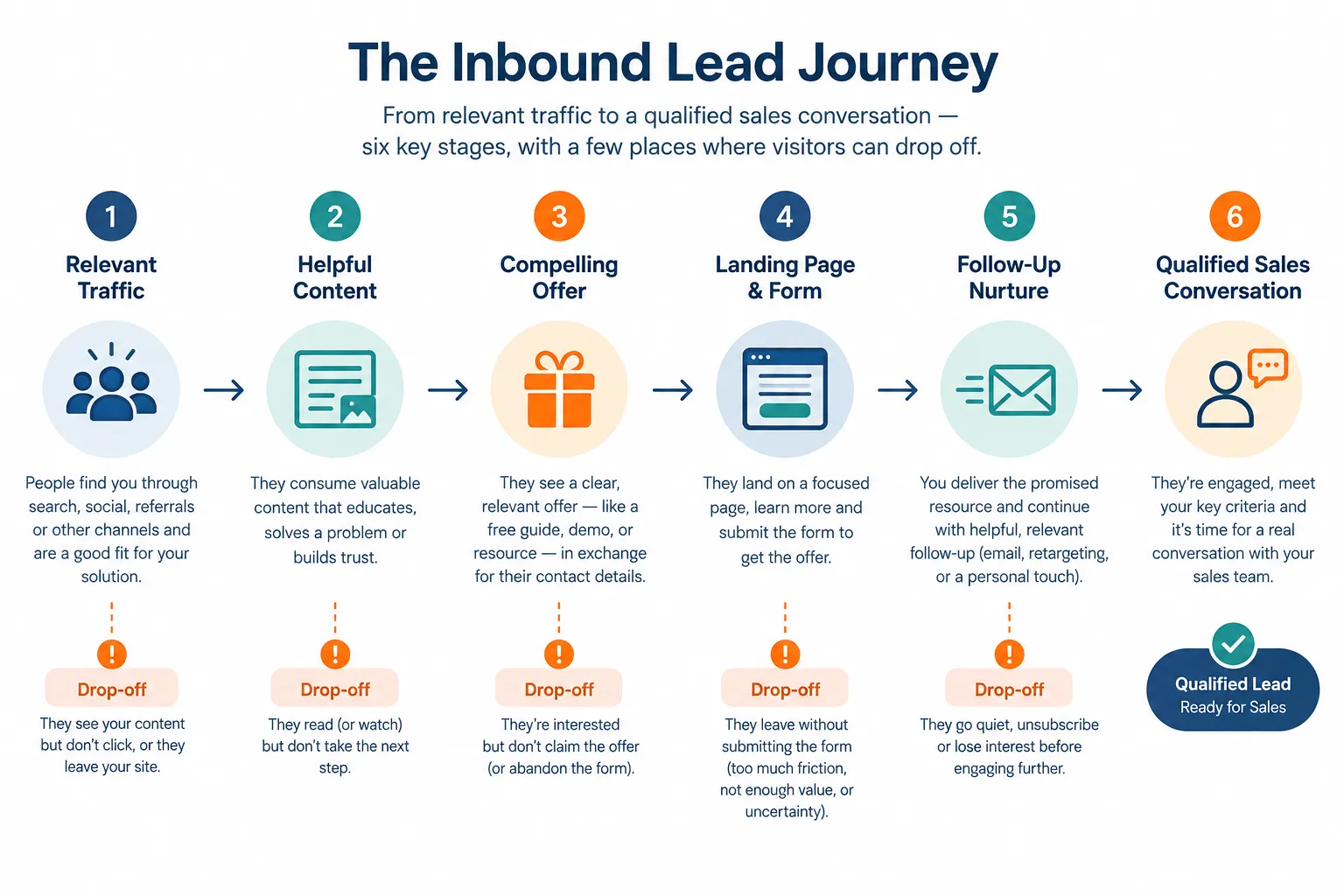
Trace one real journey: search query or referral → content page → call to action (CTA) → offer page → form → confirmation → follow-up → sales conversation. Each transition can lose a good prospect for a different reason.
|
What you see |
Likely point of friction |
First change to try |
|---|---|---|
|
Visits rise, offer clicks do not |
Content answers a broad question but gives no relevant next step |
Add one CTA tied to the question the page answers |
|
Offer clicks rise, submissions do not |
Landing page or form creates uncertainty or effort |
State what the visitor receives; remove fields you do not need yet |
|
Submissions rise, conversations do not |
Leads lack fit or responses go astray |
Define qualification criteria and assign an owner for each inquiry |
|
Conversations rise, opportunities do not |
The offer attracts curiosity rather than buying intent |
Separate educational leads from sales-ready requests and review source quality |
Pick the weakest transition and change one thing there. Compare the next set of visitors with the previous one before you adjust another stage.
Inbound versus outbound leads
With inbound lead generation, a prospect finds a resource or asks for help and initiates contact. In outbound lead generation, your team starts the exchange through a cold call or unsolicited email. Either can lead to a sale. For an inbound quote request, give a direct answer; for a worksheet download, deliver the worksheet.
|
Approach |
Typical first contact |
What the team knows at the start |
|---|---|---|
|
Inbound |
Visitor submits a service inquiry after reading a page |
The page, offer and request reveal some of the prospect’s interests |
|
Outbound |
Seller calls a prospect who has not asked to speak |
The seller must first establish whether there is interest at all |
Attract the right traffic for inbound lead generation
Start with customers you can help. Write down the organization type, the buyer’s role, the problem that sends them searching, and the signs of a poor fit. A bookkeeping firm serving local contractors might answer “how to manage cash flow between jobs” rather than “what is accounting?” The broader topic may bring more visitors who have no need for the firm’s service.
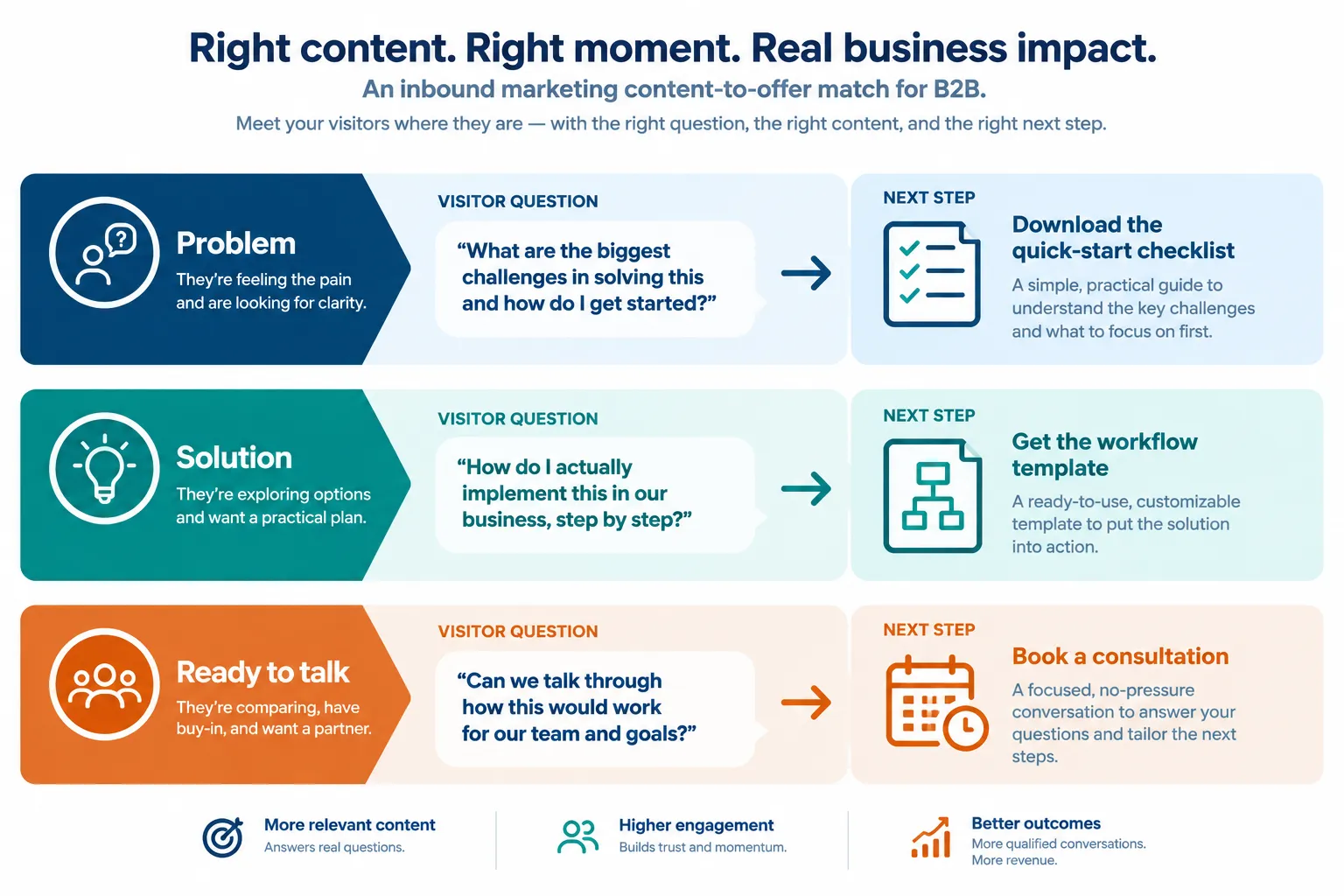
Build content around questions at different levels of intent:
-
Problem-aware: “Why are project invoices getting paid late?” Offer a checklist for spotting payment delays.
-
Solution-aware: “How to choose an invoicing process for a small contracting team.” Offer a workflow template.
-
Ready to speak: “Bookkeeping support for contractors.” Offer a consultation request.
Organic search brings visitors with questions. Email, social posts and partnerships can bring them back when they need an answer. If search traffic is shifting for your business, read about AI-powered search and small businesses. Judge each channel by its relevant visits and qualified inquiries. A narrower page that brings inquiries may serve you better than a popular article read mostly by people outside your service area.
Search, referrals and social channels
For search engine optimization (SEO), answer a buyer’s question, use their language in titles and headings, and show them the next step. A blog post about a narrow problem can reach prospects through search engines before they know your name. On a service page, explain what you offer without filling the copy with repeated search phrases.
Referred visitors still need a page that explains what you do and a way to contact you. On social media or in communities, share a specific answer or example and point interested people to a relevant resource. Track the qualified conversations those sources produce alongside clicks and impressions.
Convert interest into a useful request
Give each visitor a useful next step
Give visitors a next step that fits the task that brought them in. Someone reading a basic definition may want a worksheet or comparison template before talking to sales. Someone studying your service page may be ready to request a quote, consultation or product walkthrough.
“Get the contractor cash-flow worksheet” tells readers what they will receive. “Learn more” leaves them guessing. Place the CTA after enough explanation to make the offer useful, and repeat it near the end of a long page. You can also give readers two distinct choices: “Download the worksheet” or “Discuss bookkeeping support.”
Leave basic answers accessible. Readers can use them to decide whether they want your deeper worksheet. A gated template or white paper should offer enough extra value to justify a request for contact information; otherwise, leave it open and offer a way to contact you nearby.
Build a landing page that earns the form submission
A visitor should see what they will get, who it is for, what happens after submitting and why they can trust your business. Match the headline to the CTA that brought them there. When you promise a contractor cash-flow worksheet, show what’s inside and how you deliver it rather than switching to a generic sales pitch.
For a consultation, say what you will discuss and what the visitor should prepare. Show a relevant customer example, a named specialist or an outline of your process if you have one. Skip vague claims and invented testimonials. On a phone, readers should be able to use the CTA, form labels, error messages and confirmation screen without zooming.
Count visits and completed submissions separately. If readers click the CTA but leave before submitting, inspect both the promise and the form. The completion rate alone will not tell you whether the wrong audience arrived or you asked for too much. For other possible causes, see common reasons digital marketing campaigns underperform.
Make the form proportionate to the offer
An educational download may require only an email address. For a consultation, you may need a business name, work email and a short description of the problem to route the request and prepare a useful response. Ask about budget or timing if your team will use the answer and the visitor can provide it.
Write labels that make sense without placeholder text. Mark required fields, explain errors and tell visitors how you will use their information. Send the promised file to anyone who requests it. Ask separately for permission to send ongoing marketing rather than treating a download request as consent to a sales meeting.
Submit the form yourself. Check the confirmation message, delivery email and team notification; a recorded submission does not tell you whether the file or inquiry reached its destination.
Follow up while the request is relevant
InsideSales examined inbound leads and sales activity in 2021 and found a marked difference in conversion rates by time to first contact. The finding describes observed activity and does not predict the lift your team would see:
“Conversion rates were more than eight times higher for a first contact attempt within five minutes than for attempts made between five minutes and 24 hours.” – InsideSales
An earlier study of 1.25 million sales leads found that firms attempting contact within an hour were nearly seven times as likely to qualify a lead as firms that tried an hour later. Researchers measured qualification rather than completed sales. Respond promptly to people who ask to talk, and give downloaders the resource they requested.
Give sales-ready requests to a named person or an assigned owner in a shared queue. Confirm what the prospect asked for and explain what happens next. If they described a specific problem, acknowledge it in your reply and suggest a sensible next step.
For educational downloads, deliver the asset first, then send related help if the person opted in. For more on that channel, read why email still matters in digital marketing. Invite a conversation when it suits the request. Inbound sales begins with what the person read, asked for and said about speaking with your team.
Marketing and sales should agree on which requests get a direct response, who owns them and where to record the outcome. When sales rejects an inquiry, record why. “Outside service area” suggests a targeting problem; “not ready yet” suggests a different follow-up.
Measure lead quality, not just volume
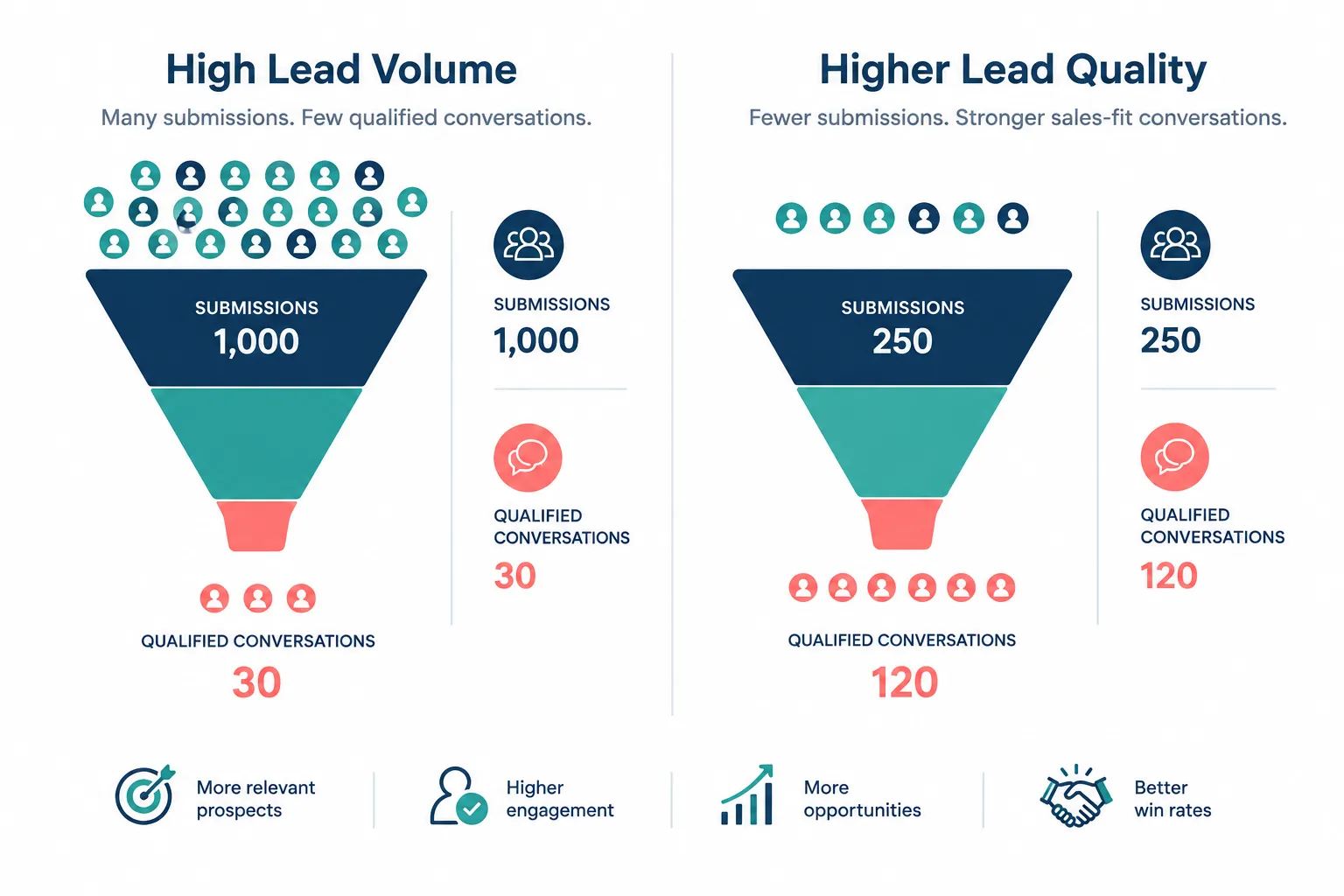
Agree on definitions before building a dashboard. A lead has submitted a request or opted in. A marketing-qualified lead (MQL) fits your customer profile and shows relevant interest. A sales-qualified lead (SQL) is someone your sales team accepts for direct follow-up after a review or conversation. Set thresholds around how your team sells.
Use simple lead scoring when volume demands it
If your team can read every inquiry, use a fit checklist. When volume makes that difficult, score signals that help you prioritize: a relevant job title or company type, a stated problem you solve, or an explicit request to speak. A download by itself says little about buying intent. Record why sales accepts or rejects leads and adjust the rules using that feedback. Use the score to route requests, not to assume someone will become a customer.
|
Measure |
Calculation |
What it helps diagnose |
|---|---|---|
|
CTA click rate |
CTA clicks ÷ relevant page visits |
Whether the next step is visible and compelling |
|
Landing page submission rate |
Completed submissions ÷ landing page visits |
Whether the offer and form match the promise |
|
Qualified lead rate |
Qualified leads ÷ submitted leads |
Whether the offer attracts the right people |
|
Lead-to-conversation rate |
Relevant sales conversations ÷ leads sent to sales |
Whether routing and follow-up work |
|
Opportunity rate by source |
Opportunities ÷ leads from that source |
Which topics and channels bring likely buyers |
Suppose 100 people visit a landing page and 10 submit the form. The submission rate is 10%. If two fit your customer profile, the qualified lead rate is 20%. Inspect the source and offer before treating all 10 submissions as promising leads. These numbers illustrate the calculation; they are not benchmarks.
Review each page with its offer and traffic source. An early-stage post may help someone who returns later, while a service page may bring fewer, more immediate requests. Attribution becomes less clear when visitors use multiple devices or channels. Read sales feedback alongside analytics to understand which requests your team could act on.
Put the workflow to work with a small team
Choose one service or product and one buyer problem first. Then:
-
Define what a good inquiry looks like and name two disqualifying conditions.
-
Identify a page that attracts relevant visitors. Match it to one offer at an appropriate stage.
-
Write a CTA with a clear promise and create a landing page that repeats that promise.
-
Ask only for information you will use, then submit the form yourself and follow the delivery and routing.
-
Assign an owner to sales requests, and give educational leads the asset they asked for.
-
Each week, inspect the transitions in the funnel and read a sample of lead notes before changing the page or offer.
Start with one complete path from a relevant visit to a request your team can act on. Measure where that path breaks before you invest in more traffic. As you work through related questions about marketing, SEO, web design and business growth, use MikeGingerich.com for practical ideas you can apply to the next improvement.
FAQ
What is inbound marketing?
Inbound marketing attracts people through useful content and experiences they choose to engage with, rather than relying only on unsolicited outreach. For lead generation, it connects a relevant question to an appropriate offer and a clear way to respond.
What is lead gen in marketing?
Lead generation is the process of getting potential customers to express interest and share a way to contact them. In inbound marketing, that may happen through a worksheet request, consultation form or other relevant offer. A submission becomes more useful when you also assess fit and follow up on the request.
What does “inbound sales” mean?
Inbound sales is a sales approach that begins with a prospect’s expressed interest and context. A salesperson responds to what the person asked for and helps determine whether there is a real fit, instead of treating every download as a request for a pitch.