Digital Marketing Strategy for Small Business
A digital marketing strategy for small business you can run: set goals, pick a lean channel mix, follow a 90-day plan and measure what matters.
 11 min read
Small business owners do not need a bloated marketing playbook. They need a plan they can actually run with limited time, limited budget, and a small team.
That is where most advice on digital marketing for small business misses the mark. It tends to be either too basic to be useful or too enterprise-focused to be practical. A real strategy for operators should answer a few simple questions:
What are we trying to achieve?
Which channels deserve our time first?
How much should we spend?
What should we do every week?
How do we know it is working?
This guide is built for that reality. It brings together the strongest ideas seen across leading competitor articles, but goes further by filling the gaps they often leave behind: budget allocation, execution priorities, channel sequencing, and how to keep your plan manageable over time. If you want online marketing for small businesses that feels realistic instead of theoretical, start here.
What most small business marketing advice gets wrong
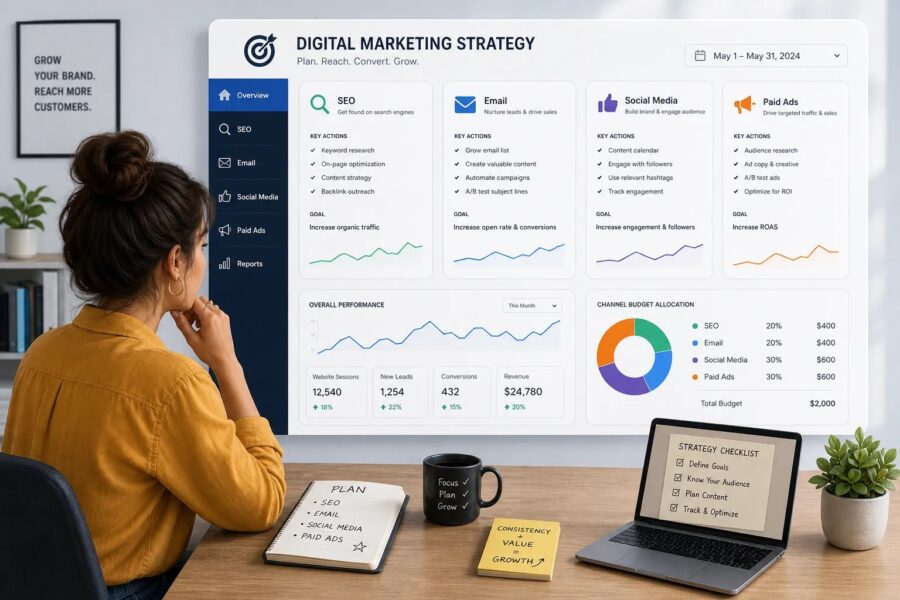
Many articles agree on the core channels: SEO, email, social media, content, and paid advertising. That part is true. The problem is that simply listing channels is not a strategy.
What small business operators actually need is:
a way to prioritize channels
a realistic timeline
a simple budget model
clear responsibilities
a short list of metrics that matter
That is the difference between activity and traction.
A good digital marketing strategy does not ask you to be everywhere. It helps you become visible in the few places where your best customers already spend time and make decisions.
This is especially important for founders who are also juggling sales, operations, hiring, and customer service. If that sounds familiar, start with a few marketing automation first steps so follow-up keeps running while you handle everything else.
What a digital marketing strategy for small business should actually do
A practical digital marketing strategy should produce five outcomes:
Outcome | What it means |
|---|---|
Visibility | More of the right people discover your business |
Credibility | Prospects trust you before they contact you |
Lead flow | You create a repeatable way to generate inquiries |
Conversion | More visitors become customers |
Retention | Existing customers come back and refer others |
If your current marketing does not clearly support those five outcomes, it is probably too scattered.
Start with business goals, not marketing tactics
Before choosing channels, define the business result you need over the next 6 to 12 months.
Good small business marketing goals
Strong goals are specific and operational. For example:
Increase qualified leads by 25% in 6 months
Generate 40 booked consultations per month
Grow ecommerce revenue by 15% quarter over quarter
Improve repeat customer purchases by 20%
Reduce customer acquisition cost from paid campaigns
These are far more useful than goals like “post more on Instagram” or “improve brand awareness.”
Match the goal to the channel
Different channels solve different problems.
Business goal | Best-fit channels |
|---|---|
More local leads | Local SEO, Google Business Profile, reviews, search ads |
More online sales | SEO, email, retargeting, paid social |
Better retention | Email, SMS, loyalty campaigns, remarketing |
Faster awareness | Social content, partnerships, paid ads, short-form video |
Higher trust | Educational content, testimonials, case studies, search visibility |
A smart digital marketing business plan begins by making these matches intentionally.
Know your buyer before you pick your channels
Small businesses often waste budget because they choose channels based on trends instead of customer behavior.
Ask these questions:
Where do customers first hear about businesses like yours?
Do they search Google with urgent intent?
Are they influenced by Instagram, YouTube, or LinkedIn?
Do they compare options for days, or buy quickly?
Is location a major factor in their decision?
Your answers determine your mix.
A simple audience snapshot
Use this framework:
Category | Questions to answer |
|---|---|
Problem | What pain point are they trying to solve? |
Intent | Are they researching or ready to buy? |
Channel behavior | Where do they discover and compare options? |
Objections | What makes them hesitate? |
Trigger | What causes them to act now? |
This exercise often reveals that digital marketing for small companies works best when the first focus is not “all channels,” but one search-driven and one relationship-driven channel.
The best channel mix for most small businesses
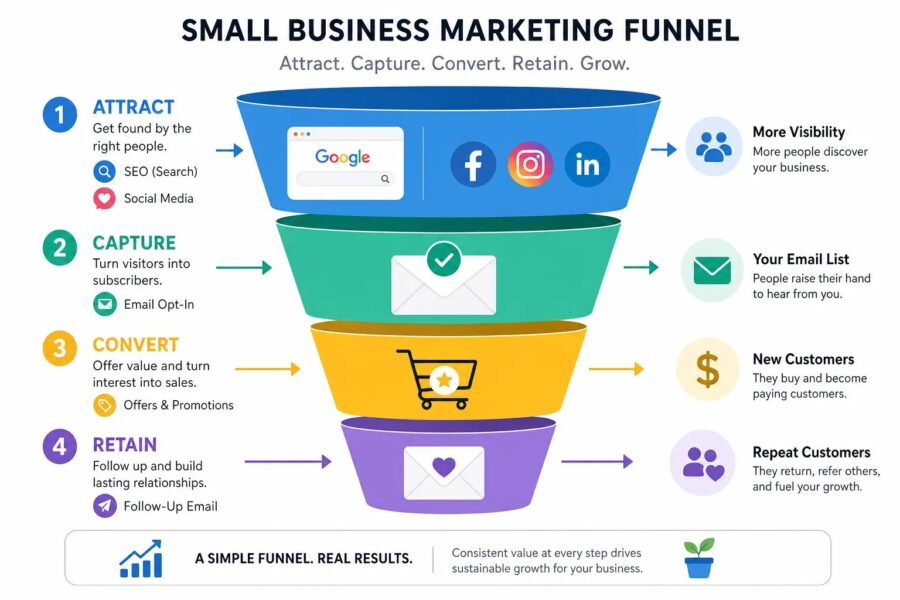
For most businesses, the strongest starting mix is:
SEO or local SEO for long-term visibility
Email marketing for lead nurturing and repeat business
One primary social platform for awareness and trust
Selective paid ads to accelerate what is already working
That combination gives you both short-term and long-term growth.
Channel-by-channel strategy
SEO: build demand that compounds
SEO is one of the few channels that can keep working after the initial effort is done well. For service businesses, local SEO can be especially powerful. For ecommerce and digital-first brands, content-led SEO can become a steady acquisition engine.
Focus on:
service pages built around real customer searches
city or local intent pages if geography matters
FAQs based on buying objections
comparison and educational content
strong page titles, headings, and internal links
Google Business Profile optimization and reviews
Many businesses struggle here because they create content without structure. If your content gets traffic but not leads, tighten the path from search to inquiry first. Our guide to search engine marketing shows how to match pages to what buyers are actually searching for.
Email: the most underused small business asset
Email remains one of the highest-control channels because you own the audience. You are not dependent on algorithm changes the way you are with social media.
Use email for:
welcome sequences
abandoned cart or abandoned inquiry follow-up
quote reminders
seasonal campaigns
education and trust building
reactivation of past customers
referrals and review requests
For small teams, automation matters more than volume. A short, effective sequence beats random blasts.
Social media: choose one core platform first
A common mistake in digital marketing small business planning is trying to maintain five platforms badly instead of one platform well.
Choose based on business model:
Business type | Strong starting platform |
|---|---|
Local lifestyle brand | Instagram or Facebook |
B2B services | |
Visual product brand | Instagram, Pinterest, TikTok |
Education or expertise-led brand | YouTube, LinkedIn |
Community-first small business | Facebook, Instagram |
The goal is not daily posting for its own sake. The goal is to create visibility, proof, and familiarity.
Good social content for small businesses usually falls into these categories:
customer proof
behind-the-scenes trust builders
frequently asked questions
short tips
before-and-after results
founder perspective
offers and events
Paid ads: amplify what already converts
Paid ads work best when they support a proven offer, not when they try to rescue a weak one.
Use paid channels when:
you know what message already resonates
your landing pages convert
your lead handling process is fast
your average customer value justifies the spend
For many small businesses, a sensible paid starting point is:
Google Search Ads for high-intent demand
Meta retargeting ads for visitors and leads who did not convert
selective paid social for local awareness or promotions
Do not start with large budgets. Start with controlled tests.
A realistic 90-day digital marketing plan
This is where competitor content is often thin. Small business owners do not just need channel descriptions. They need a rollout plan.
Days 1-30: build the foundation
Focus on essentials:
clarify your main offer
define your audience and goals
update your website messaging
improve your core service or product pages
set up analytics and conversion tracking
optimize Google Business Profile
choose one social channel
set up one automated email sequence
Days 31-60: publish and promote
Now create momentum:
publish 2 to 4 high-intent pieces of content
request reviews from recent customers
post consistently on one core social channel
launch one lead magnet or offer
start email nurture campaigns
test a small paid campaign if tracking is in place
Days 61-90: optimize and scale
Use results to refine:
identify pages and posts driving the best traffic
check which traffic converts
improve low-converting landing pages
expand winning content topics
reallocate ad spend toward best performers
add one more automation or follow-up step
This approach keeps your digital marketing strategy grounded in execution instead of wishful planning.
How to allocate a limited marketing budget
Budget is one of the biggest content gaps in competitor articles. Here is a practical model.
The simple small business budget split
If you have a very limited monthly budget, think in percentages:
Budget area | Suggested share |
|---|---|
Website, SEO, and content assets | 35% |
Paid acquisition tests | 25% |
Email and CRM tools | 15% |
Creative production | 10% |
Analytics and optimization | 10% |
Experiments | 5% |
This split changes based on business stage, but the principle stays the same: invest more in owned assets than rented attention.
If your budget is under $1,500 per month
Prioritize:
local SEO or on-site SEO
email automation
one social platform
small retargeting campaigns only after traffic exists
If your budget is $1,500 to $5,000 per month
Add:
regular content production
Google Ads for high-intent terms
better creative testing
conversion optimization
If your budget is higher
Scale only after you have:
clear attribution
stable conversion rates
reliable follow-up process
enough gross margin to absorb testing
The small-team execution model
A strong strategy must fit the reality of a small team. That usually means one owner, one generalist marketer, or a mix of internal and freelance support.
Assign roles by function, not title
Function | Owner |
|---|---|
Strategy and priorities | Founder or business owner |
Content input and expertise | Founder or subject expert |
Publishing and distribution | Marketing generalist or freelancer |
Design and creative support | Contractor or template system |
Reporting and optimization | Marketing lead or owner |
Do not wait for a “full team.” Build repeatable systems with the people you have.
How to keep your strategy simple enough to sustain
The best strategy is the one you can keep running.
Use this weekly operating rhythm:
Weekly
publish or distribute one useful piece of content
review leads and conversions
send one email campaign or monitor automations
post 2 to 4 times on your main social channel
respond to reviews, comments, and inquiries
Monthly
review channel performance
update one key landing page
test one new creative angle or offer
review budget allocation
identify one workflow to automate
Simple consistency beats complex inconsistency nearly every time.
What to measure without drowning in data
Competitor articles often mention metrics, but many still overwhelm smaller teams. You do not need dozens of KPIs.
Track these first:
Metric | Why it matters |
|---|---|
Leads or inquiries | Core output of marketing |
Conversion rate | Shows whether traffic turns into action |
Cost per lead | Indicates efficiency |
Revenue by channel | Reveals actual business value |
Email engagement | Measures audience quality and follow-up strength |
Branded search or direct traffic | Shows growing awareness and trust |
Avoid vanity traps such as follower count without engagement or traffic without conversions.
Signs your strategy is working
You know your digital marketing strategy is improving when:
lead quality gets better, not just volume
customers mention finding you through search or content
repeat business increases
your paid ads become cheaper to convert
your email list produces revenue
your website starts helping sales instead of just existing
Common mistakes that stall small business growth
Doing too many channels too early
Depth wins before breadth.
Posting without a conversion path
Traffic needs a next step: call, form, purchase, consultation, or signup.
Ignoring follow-up speed
Slow response times waste good leads.
Treating content as separate from sales
Good content answers objections and moves buyers forward.
Underinvesting in systems
Automation, tracking, and templates free up time for better decisions. If your processes are becoming chaotic as you grow, a short weekly owner checklist keeps marketing reviews from slipping.

A better way to think about digital marketing in 2026
Small business marketing is no longer just about being active online. It is about building a connected system:
search makes you discoverable
content makes you credible
email makes you memorable
social makes you familiar
paid media makes you faster
When those parts support one another, even a modest budget can produce strong results.
That is the real opportunity in digital marketing for small companies today. You do not need enterprise complexity. You need a focused operating system for growth.
Final takeaway
The best digital marketing strategy for small business is not the one with the most channels. It is the one that aligns your goals, audience, budget, and team capacity into a plan you can execute consistently.
Start with a few essentials:
one clear goal
one strong offer
one search-driven channel
one relationship-driven channel
one simple reporting routine
Then improve through repetition and measurement.
Start this week: write down one 90-day goal, pick one search channel and one relationship channel, and block 30 minutes every Friday to review the numbers.
FAQ
What is the 3-3-3 rule in marketing?
The 3-3-3 rule in marketing is often used as a simple planning framework: focus on a few core goals, a few key channels, and a few measurable actions. For small businesses, the idea is to keep strategy manageable so execution stays consistent.
What is the 70-20-10 rule in digital marketing?
The 70-20-10 rule usually means putting 70% of effort into proven tactics, 20% into optimization or adjacent opportunities, and 10% into experiments. It is a practical way for small teams to balance stability with testing new ideas.
What are the 5 main strategies of digital marketing?
The five main strategies commonly include SEO, email marketing, social media, content marketing, and paid advertising. For small businesses, the best mix depends on goals, buyer behavior, and available budget.
Is digital marketing still worth it in 2026?
Yes, digital marketing is still worth it in 2026 because it remains one of the most measurable and cost-efficient ways to reach customers. The key is not doing everything, but building a focused system across the channels that actually influence buying decisions.