Startup Scaling Guide for Founders
A startup scaling guide for founders: the signs you are ready, the systems to fix first, the mistakes to avoid and the metrics to watch as you grow.
 12 min read

Startup Scaling Guide for Founders
If your startup has early traction, a few repeatable wins, and growing pressure to “go faster,” this is the moment when discipline matters more than hype.
Scaling is not the same as growing. Growth can happen through brute force, founder hustle, or a short-term spike in demand. Scaling means your company can handle more customers, more complexity, and more team members without quality, cash flow, and execution falling apart.
For founders, that creates a practical challenge: how do you increase revenue and capacity without breaking operations, overhiring, damaging the customer experience, or burning through capital too quickly?
This guide is built for that exact stage. It focuses on what operators need to tighten before growth accelerates: systems, hiring, customer delivery, decision-making, and financial control. Instead of generic startup motivation or investor-first theory, this is about the day-to-day reality of running a company that is moving from “promising” to “under pressure.”
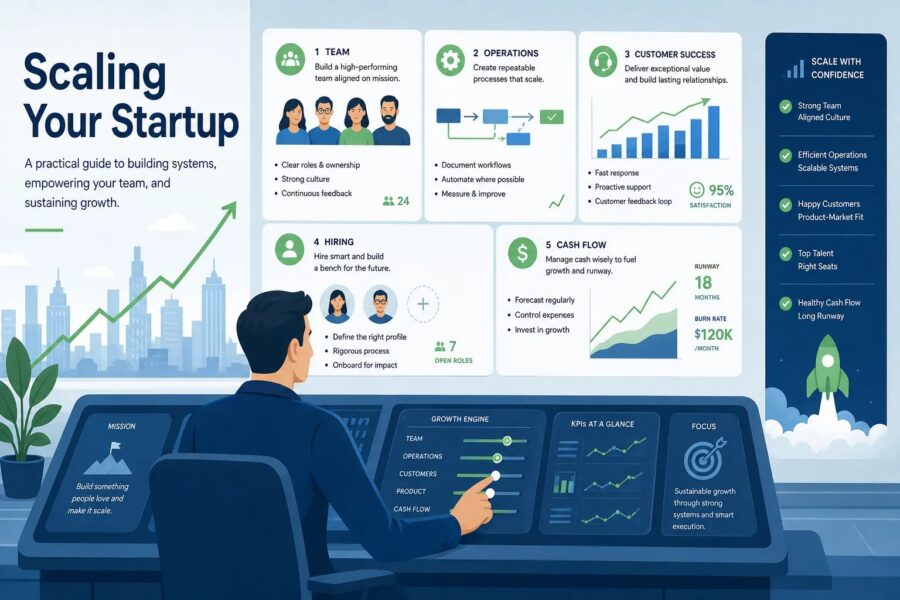
What scaling actually means
A lot of founders think scaling starts when revenue rises. In reality, scaling starts when the business can repeat success without relying on heroic effort.
That usually means:
demand is becoming more predictable
customer acquisition is no longer entirely experimental
onboarding and delivery can be documented
support issues follow recognizable patterns
managers can make decisions without the founder in every loop
the economics still work as volume increases
A startup that is not yet scalable may still be successful in short bursts. But if every new customer creates more chaos than value, the company is still in a fragile growth phase.
The clearest signs your startup is ready to scale
Founders often wait for perfect certainty, or they move too early because outside pressure builds. A better approach is to look for a cluster of readiness signals.
1. You have repeatable customer demand
The strongest sign of readiness is not “people like us.” It is “we can reliably acquire the right customers through channels we understand.”
Look for:
a clear customer profile
a value proposition that consistently converts
steady conversion patterns by channel or segment
sales cycles that are becoming more predictable
lower dependency on founder-led selling
If new deals still depend mainly on improvisation, personal relationships, or one-off pricing, your startup may still be proving itself rather than preparing to scale.
2. Retention is strong enough to justify expansion
Acquiring more customers only helps if they stay, expand, or refer others. Retention is one of the most honest indicators of whether growth is worth funding.
Founders should ask:
Do customers renew or reorder at healthy rates?
Does churn stabilize after onboarding?
Are support complaints increasing as volume rises?
Are your best customers getting enough value to stay longer?
If customers leave quickly, scaling acquisition simply speeds up waste.
3. Your delivery model is documented
A founder can manually save a small company. A scale-up needs systems.
You are closer to scale when key workflows exist beyond tribal knowledge:
sales handoff
onboarding
implementation
billing
customer support
issue escalation
reporting and forecasting
This is especially important if you plan to expand your team quickly. New hires should be able to operate from a playbook, not from guesswork.
4. Unit economics make sense before aggressive expansion
Scaling cannot fix broken economics. It usually magnifies them.
A founder should understand, at minimum:
Metric | Why it matters |
|---|---|
Gross margin | Shows whether delivery becomes healthier or weaker as you grow |
Customer acquisition cost | Tells you how expensive growth really is |
Payback period | Reveals how long cash is tied up before acquisition spend is recovered |
Retention and expansion | Indicates whether customers become more valuable over time |
Burn rate | Measures how much room you truly have to execute |
If these numbers are unclear, scaling should slow down until visibility improves.
5. The business no longer depends on one person for every major decision
This is one of the least discussed but most important signals.
If the founder approves every hire, solves every customer problem, closes every meaningful sale, and reviews every operational issue, the company is not yet built to scale. It is built around a bottleneck.
A scalable company distributes decision-making through process, accountability, and clearer ownership.
The systems to fix before growth accelerates
Many founders think scale breaks companies because demand rises too fast. More often, demand simply exposes weak systems that already existed.
This is where disciplined operators separate themselves.
Fix your operating rhythm first
Before adding more people, products, or regions, establish a predictable management cadence.
That usually includes:
weekly leadership review
monthly metrics review
quarterly planning
simple issue tracking
documented priorities by function
clear owners for major initiatives
Without an operating rhythm, growth turns into constant reaction. Teams become busy but misaligned.
A practical rhythm also helps reduce the founder’s need to personally coordinate every moving part. If you want a broader view of operational discipline and efficiency, this weekly owner checklist shows the same core principle: scale works better when repeatable processes replace manual firefighting.
Standardize the customer journey
As volume grows, inconsistency becomes expensive.
Map the customer lifecycle from first touch to renewal or repeat purchase:
lead capture
qualification
sale
onboarding
delivery
support
expansion or renewal
For each stage, define:
who owns it
what the handoff looks like
what the customer should expect
which tools support it
what can go wrong
what metric reflects quality
Most scaling problems show up in the gaps between teams, not inside a single team. Sales promises one thing, operations delivers another, and support cleans up the aftermath.
Create minimum service standards
As you grow, customer experience should not depend on which employee happens to be involved.
Set baseline standards such as:
response-time expectations
onboarding completion targets
implementation timelines
escalation rules
communication templates
account review schedules
This does not make your business robotic. It makes quality more reliable.
Upgrade financial visibility before you need it
A startup can survive for a while with rough numbers. A scaling company cannot.
Founders need a near-real-time view of:
monthly burn
runway
gross margin by product or segment
cash conversion timing
hiring commitments
revenue concentration
accounts receivable risk
The goal is not accounting perfection. The goal is decision-quality visibility.
A simple financial dashboard often matters more than a complex spreadsheet model no one trusts. This is also where many startups underestimate the operational side of scale. If your infrastructure is still fragmented, start by choosing one system of record for customers, such as a CRM (see how to choose CRM software for a small business), especially if your business relies on digital workflows across teams.
Build a hiring system, not just a recruiting push
When founders say, “We need to hire fast,” they often mean, “We are overloaded.” That is understandable, but dangerous.
Scaling teams successfully requires more than adding headcount. It requires role design.
Before hiring, answer:
What outcomes should this role own in 6 months?
What decisions can this person make independently?
What skills are truly required versus merely preferred?
What process will this person inherit?
Who will manage and train them?
What metric will prove the hire was successful?
Fast hiring without role clarity creates expensive confusion. It also overloads your strongest people, who must constantly coach, correct, and compensate.
Hire for stage-fit, not prestige alone
A person who succeeded in a 2,000-person company may struggle in a resource-constrained startup. A brilliant early employee may also struggle once specialization and managerial complexity increase.
The right question is not “Who looks impressive?” It is “Who can help this company at this stage?”
Stage-fit talent tends to have:
comfort with ambiguity, but respect for process
ability to build systems, not just execute tasks
cross-functional communication skills
judgment under incomplete information
willingness to document and train others
Where scaling usually breaks
Most founders expect pressure in sales or fundraising. In practice, the real breakpoints are often more mundane and more dangerous.
Common scaling mistakes founders make
Scaling revenue before stabilizing fulfillment
Selling faster than you can deliver creates hidden liabilities:
refund risk
churn
reputational damage
employee burnout
support backlog
weak referrals
Short-term topline growth can mask long-term damage.
Overhiring to solve process problems
Sometimes the real issue is not capacity. It is lack of clarity.
More people added to a broken workflow often produce:
duplicate work
unclear ownership
slower decisions
rising payroll without higher output
Always fix the process before assuming headcount is the cure.
Expanding channels too early
It is tempting to add geographies, customer segments, and marketing channels all at once. But complexity compounds quickly.
Every new channel can require:
new messaging
different sales motions
operational changes
separate support expectations
localized compliance or billing changes
A focused expansion strategy usually outperforms scattered experimentation.
Ignoring middle-management gaps
Founders often pay attention to executives and individual contributors while overlooking the management layer that translates plans into execution.
When this layer is weak, scale suffers through:
poor delegation
inconsistent coaching
weak accountability
cross-functional confusion
Management quality becomes a growth lever much earlier than many startups expect.
Treating customer support as a cost center
In an early-stage company, support often contains the clearest signal about friction, churn risk, product confusion, and operational breakdown.
If you underinvest in support during scaling, you also blind yourself to problems that are getting worse.
How to prioritize team, process, and customer experience together
One of the biggest founder mistakes is treating these as separate workstreams. They are connected.
weak process creates team stress
team stress hurts customer experience
poor customer experience increases churn
churn puts pressure on revenue
revenue pressure drives rushed decisions
The companies that scale cleanly tend to coordinate all three.
A practical founder framework: what to fix first
Use this order of operations when deciding where to focus.
First: protect customer value
Ask:
What must remain true for the customer as we grow?
Where are we already disappointing customers?
Which promises are hardest to deliver consistently?
If growth damages customer value, nothing else matters for long.
Second: remove recurring internal friction
List the problems your team solves repeatedly every week. These usually point to system failures.
Examples:
inconsistent onboarding data
unclear pricing approvals
delayed invoicing
messy support escalation
handoff breakdowns between sales and operations
If the same issue keeps returning, it is a systems problem.
Third: clarify ownership
Every critical process should have a clear owner. Not a group. Not “leadership.” One accountable person.
Ownership reduces latency. It also lowers founder dependency.
Fourth: automate and document the repetitive
This includes:
approvals
reminders
reporting
customer status updates
internal requests
onboarding checklists
Documentation is not bureaucracy when it removes confusion and speeds execution.
Fifth: add headcount only after the work is structured
Once the workflow is clearer, you can hire into a better environment. That improves ramp time, performance, and retention.
A startup scaling checklist for operators
The table below can help founders quickly assess whether they are scaling from strength or from pressure.
Area | Healthy sign | Warning sign |
|---|---|---|
Demand | Repeatable pipeline and defined ICP | Growth depends on founder hustle |
Retention | Customers stay and expand | Churn rises as volume grows |
Delivery | Processes documented and measurable | Teams improvise for every account |
Hiring | Roles tied to outcomes and ownership | Hiring happens mainly from urgency |
Finance | Runway, burn, and margins visible | Decisions rely on outdated numbers |
Management | Leaders run a regular cadence | Founder becomes the coordination layer |
Support | Customer issues inform improvement | Support is overwhelmed or ignored |
Expansion | Growth priorities are focused | Too many channels or markets at once |
What founders should measure during a scaling phase
Metrics should help you decide faster, not create reporting theater.
A practical scaling dashboard often includes:
Commercial metrics
pipeline quality
win rate
sales cycle length
customer acquisition cost
payback period
Customer metrics
onboarding completion
time to value
retention
expansion revenue
support response and resolution time
Operational metrics
implementation cycle time
backlog volume
error rates
fulfillment consistency
team capacity utilization
Financial metrics
burn rate
runway
gross margin
net revenue retention if relevant
cash collected versus revenue booked
Not every startup needs every metric immediately. But every scaling startup needs trusted visibility across revenue, delivery, and cash.
How to know whether you are moving too fast
Founders often discover this too late. Watch for these warning signs:
customer complaints are rising faster than customer count
internal meetings multiply but decisions slow down
leaders spend more time escalating than solving
new hires need constant rescue
invoicing or cash collection gets messy
product quality slips because teams are rushed
your top performers look exhausted every week
Speed is only useful when the company can absorb it.
In some cases, the smartest scaling move is not acceleration. It is deliberate stabilization for one or two quarters so the next phase of growth lands on stronger ground.
The overlooked part of scaling: operational resilience
A lot of startup advice talks about growth strategy, funding, and market size. Less attention goes to resilience: the business’s ability to keep functioning under strain.
That includes:
backups for critical responsibilities
vendor and tool reliability
documentation for edge cases
basic compliance hygiene
clean data flows between systems
contingency plans for cash pressure or service disruption
Operational resilience is not glamorous, but it often decides whether a startup can sustain momentum after its first serious growth spurt. The same logic applies across industries: businesses become more scalable when they strengthen repeatability, capacity, and flexibility. Write those priorities into your startup business plan so the whole team scales against the same targets.
The founder’s role changes during scale
One of the hardest parts of scaling is personal, not operational.
The founder who got the company to early traction often succeeds through speed, instinct, and direct involvement. But the founder who leads through scale needs different strengths:
prioritization over constant reaction
systems thinking over individual heroics
coaching over fixing
accountability over improvisation
clarity over intensity
That transition is uncomfortable because it can feel less hands-on. In reality, it is often more valuable.
A founder’s job during scale is increasingly to design the company so that good decisions happen without their presence in every room.
Final verdict: scale what works, fix what breaks, ignore the hype
The best scaling companies do not grow because they move recklessly. They grow because they make the business sturdier before volume exposes weaknesses.
If you have early traction, the goal is not simply to add more. The goal is to make success repeatable.
That means:
validating demand before expanding aggressively
protecting the customer experience
tightening workflows before overhiring
building financial visibility early
giving ownership to capable leaders
treating operational discipline as a growth advantage
Pick the one weak point that hurts customers most this month, fix it, and only then add more volume.