Claude Wrote Over 80% of Anthropic’s Merged Code

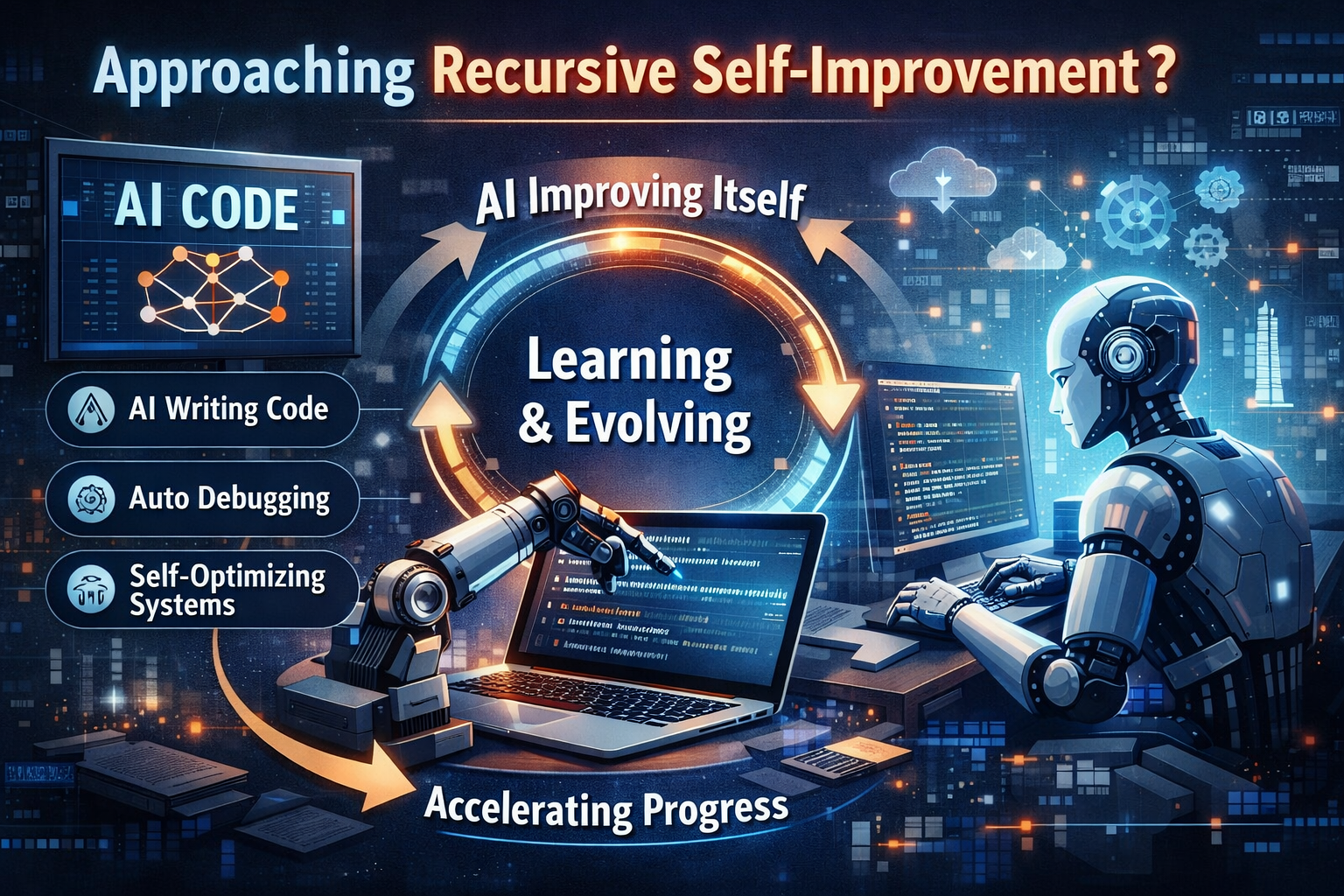
Anthropic revealed in a detailed report published on June 4, 2026, that more than 80% of the code merged into Anthropic’s codebase as of May 2026 was authored by Claude, marking a dramatic shift in how the company develops its own AI systems. The disclosure, shared on Anthropic’s website, provides the most comprehensive public data to date on AI-driven software development and suggests the industry may be approaching what researchers call recursive self-improvement, where AI systems can meaningfully contribute to building their own successors.
Before Claude Code launched in research preview in February 2025, this number was in the low single digits, highlighting the rapid acceleration of AI-assisted development in just over a year. The productivity impact has been substantial, with the typical engineer merging 8× as much code per day in the second quarter of 2026 as they were in 2024.
Performance Improvements and Real-World Impact
The report details significant improvements in Claude’s coding capabilities over the past six months. On the most open-ended tasks, Claude’s success rate reached 76% in May 2026, up 50 percentage points in six months. These open-ended tasks represent some of the most challenging engineering problems, where clear specifications are initially absent and significant debugging is required.
One striking example from April 2026 demonstrates the scale of work AI can now handle. An Anthropic engineer deployed Claude to resolve a persistent class of API errors. Operating autonomously, the model shipped more than 800 individual fixes, successfully reducing the error rate by a factor of 1,000. The supervising engineer estimated that a human developer would have spent four full years executing the same work.
In another incident, an engineer pointed Claude at a live incident where a routine upgrade began crashing tens of thousands of training jobs. Working through the running jobs and testing one environment setting at a time, Claude isolated the single obscure debugging flag that was triggering the crash, reproduced it reliably, and confirmed a fix in about two hours, delivering what would normally be two to three days of work.
Code Quality and Human Oversight
While productivity metrics show dramatic improvements, questions about code quality remain central to the discussion. Many believe that the Claude-written code was still worse in quality than human-written code at Anthropic in late 2025, and is roughly at parity today. The company expects AI-generated code quality to surpass human-written code within the year.
The shift has introduced new challenges for engineering teams. Some of the technical managers at Anthropic are exhausted by keeping up with all the code their teams now produce. Part of things happening so much more quickly is just managing your time, according to Claude engineering lead Katelyn Lesse.
At a recent developer event in London, when an Anthropic engineer asked attendees who had shipped pull requests completely written by Claude without reading the code at all, a noticeable portion of the audience raised their hands, according to coverage from MIT Technology Review.
Broader Industry Implications
The surge in AI-generated code is affecting infrastructure providers beyond Anthropic. GitHub saw roughly one billion code commits in all of 2025; by mid-2026 it saw 275 million a week, on pace for roughly 14 billion over the year. The company’s COO has said that it is “pushing incredibly hard” on capacity just to keep up.
Anthropic publicly framed these developments as a potential turning point. In an official statement on X, the company observed: “Our internal data shows Claude is accelerating AI development—a possible path to recursive self-improvement, or AI autonomously building a more capable successor. It’s happening faster than we thought, and the implications deserve greater attention”.
Major enterprises are already deploying Claude Code in production environments. Stripe deployed Claude Code across 1,370 engineers of all levels through a zero-configuration enterprise binary. One team completed a 10,000-line Scala-to-Java migration in four days, work estimated at ten engineer-weeks. Similarly, Wiz migrated a 50,000-line Python library to Go in roughly 20 hours of active development, a project the team estimated at two to three months of manual work.
Cultural and Organizational Shifts
The transformation is reshaping the role of software engineers at Anthropic. At Anthropic, the majority of code is now written by Claude Code. Engineers focus on architecture, product thinking, and continuous orchestration: managing multiple agents in parallel, giving direction, and making the decisions that shape what gets built.
The psychological impact on individual engineers has been significant. One researcher quoted in the report shared that they have not hand-written code themselves in approximately five months, describing days where automation makes them question their role, contrasted with frustrating moments when systems break in ways they no longer fully understand.
Key Facts
- More than 80% of code merged into Anthropic’s codebase as of May 2026 was authored by Claude
- The typical Anthropic engineer was merging 8× as much code per day in Q2 2026 compared to 2024
- Claude’s success rate on the most open-ended tasks reached 76% in May 2026, up 50 percentage points in six months
- Claude autonomously shipped 800+ fixes in April 2026, reducing a class of API errors by a factor of 1,000
- Before Claude Code launched in February 2025, AI-authored code at Anthropic was in the low single digits
- GitHub is on pace for roughly 14 billion code commits in 2026, up from one billion in 2025
Sources
- When AI builds itself – Anthropic
- Anthropic says 80% of its new production code is now authored by Claude – VentureBeat
- Anthropic’s Code with Claude showed off coding’s future – MIT Technology Review
- Claude Code – Anthropic
Sources
- When AI builds itself \ Anthropic
- Anthropic says 80% of its new production code is now authored by Claude — how your enterprise can keep up | VentureBeat
- Anthropic’s Code with Claude showed off coding’s future—whether you like it or not | MIT Technology Review
- Claude Code | Anthropic’s agentic coding system \ Anthropic