Claude Now Writes 80% of Anthropic’s Code; Company Warns

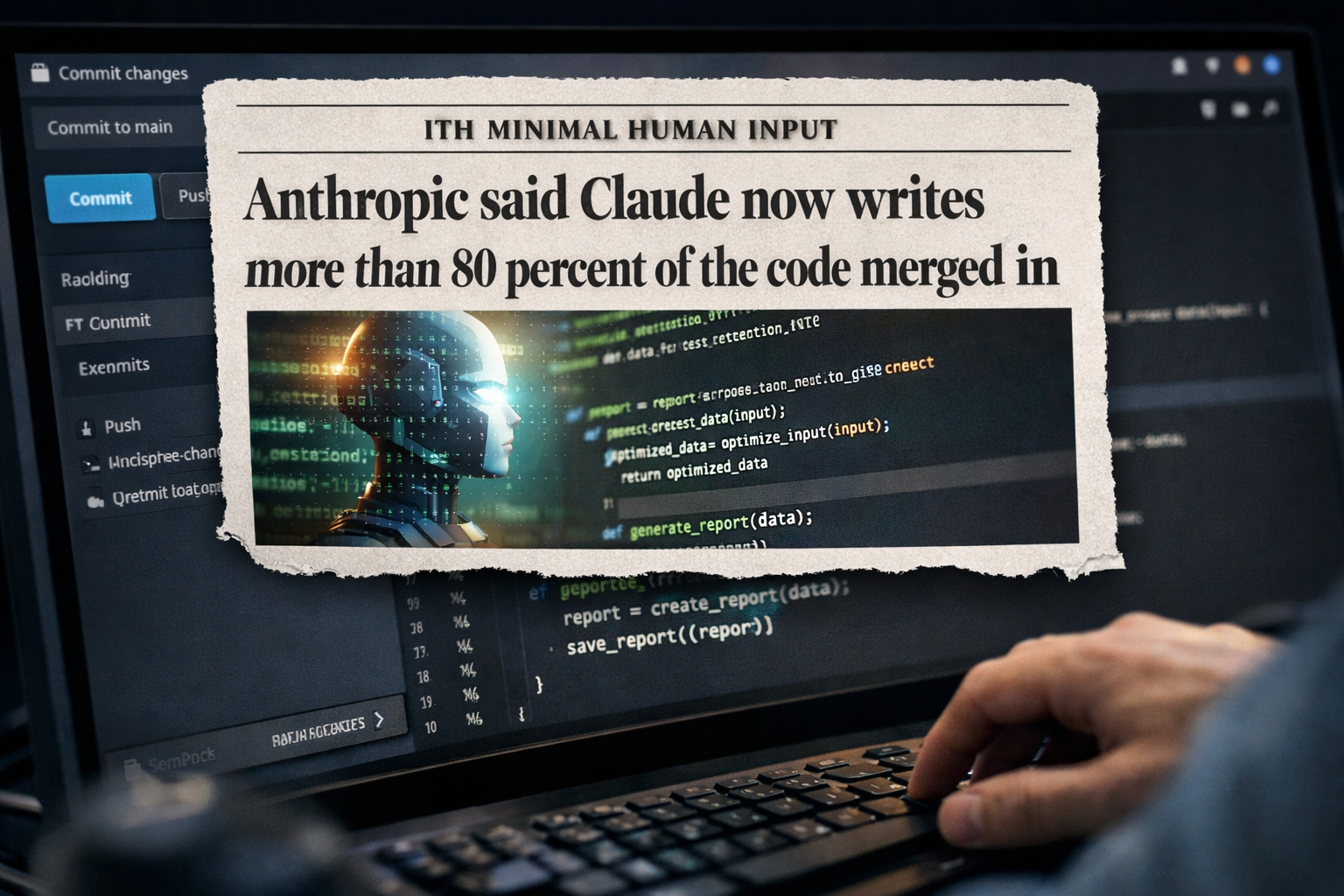
Anthropic’s AI assistant Claude now authors more than 80% of the code merged into the company’s production systems as of May 2026, a dramatic increase from low single-digit percentages before the company released Claude Code in early 2025. The disclosure came in a June 4, 2026 report from the Anthropic Institute, where the company warned that AI systems may be approaching what it calls “recursive self-improvement,” the point at which they could design and build their own successors with minimal human input. Anthropic said Claude now writes more than 80 percent of the code merged into its systems, up from low single digits before the company released Claude Code in early 2025.
The company said this could increase the risk of humans losing control of the technology and proposed that “it would be good for the world to have the option to slow or temporarily pause frontier AI development to enable societal structures and alignment research to keep up with the advance of the technology.”
Dramatic Productivity Gains at Anthropic
Anthropic’s engineers ship around eight times as much code per quarter as they did a few years ago. The company attributed this acceleration directly to Claude’s growing capabilities in software development tasks. One of Anthropic’s engineers hasn’t written a line of code in five months, not because the work dried up, but because Claude does it now.
Success rates on complex, open-ended engineering problems rose to 76% in May 2026. This represents a significant improvement from just six months earlier. In April 2026, Claude shipped over 800 fixes that reduced a class of API errors by a factor of one thousand, and the engineer overseeing Claude estimated that a human would have taken four years to complete this work.
Benchmarks Show Accelerating Capabilities
Anthropic uses an internal benchmark to measure coding capabilities across model generations. Claude Mythos Preview, a frontier model previewed in April 2026, achieved a 52x speedup over baseline code on optimization tasks, where a skilled human researcher would need four to eight hours to achieve a 4x improvement. This performance marks a substantial increase from earlier models.
The company also tested Claude’s research judgment by showing it real coding sessions where a human researcher took a wrong turn. When Claude could pick a better “next step” than a human researcher at difficult junctures during real research sessions, in November 2025, Claude matched the human’s judgment 51% of the time, but by April 2026, that rose to 64%.
Broader Industry Impact
The effects of AI-assisted coding are visible across the software development industry. GitHub saw roughly one billion code commits in all of 2025, but by mid-2026 it saw 275 million a week, on pace for roughly 14 billion over the year. Claude Code alone accounts for 4.5% of all public commits on GitHub, generating 2.6 million weekly.
GitHub’s COO has said that it is “pushing incredibly hard” on capacity just to keep up. The infrastructure strain reflects the scale at which AI coding assistants are now operating across the industry.
Call for Coordinated Slowdown
Anthropic floated what it called “a global coordination mechanism” to slow or even pause AI development and allow society room to catch up. However, the company acknowledged the practical challenges of such an approach. The company said “we are not there yet, and recursive self-improvement is not inevitable,” but added that “it could come sooner than most institutions are prepared for.”
The company has not halted internal development as of the time of publication. Anthropic indicated it would only consider slowing its own development if rival labs at or near the frontier did the same in a verifiable manner.
Mixed Reactions from Experts
The call for a pause came just days after Anthropic confidentially filed for an initial public offering and not long after a funding round that valued the company at close to $1 trillion, and to skeptics, such startling pronouncements can read as business strategy, a way to draw regulatory scrutiny to the frontier while Anthropic continues racing toward it.
Some academics remain skeptical of the recursive self-improvement narrative. One computer science professor suggested the evidence of increased AI-written code indicates the technology is helpful but does not necessarily represent a fundamental leap toward autonomous AI development.
What Recursive Self-Improvement Means
In the future, agents could become capable enough to build and train models themselves, and if this happens, future versions of Claude could be continuously improved by Claude itself. This scenario, which Anthropic calls recursive self-improvement, would represent a significant shift in how AI systems evolve.
Full recursive self-improvement might increase the risks of humans losing control over AI systems, and if systems are capable of fully building their own successors, the ways we secure them, monitor them, and shape their behavior all grow much more important.
Key Facts
- Claude authors more than 80% of code merged into Anthropic’s production systems as of May 2026, up from low single digits in early 2025
- Anthropic engineers ship 8x as much code per quarter compared to 2021-2025
- Claude’s success rate on open-ended engineering problems reached 76% in May 2026
- Claude Mythos Preview achieved a 52x speedup on optimization tasks in April 2026, compared to 4x for skilled humans
- GitHub is processing 275 million commits per week in mid-2026, up from 1 billion total in 2025
- Claude Code accounts for 4.5% of all public GitHub commits
- Anthropic called for a global mechanism to slow or pause frontier AI development on June 4, 2026
Sources
- When AI builds itself – Anthropic Institute
- Anthropic warns AI may soon begin recursive self-improvement – Scientific American
- Claude writes 80% of its code, calls for AI pause – The Next Web
- Anthropic warns Claude AI is building itself faster than expected – Tom’s Hardware