Workplace Trends Leaders Should Watch in 2026
Workplace trends for 2026 that need a leader's decision: AI in everyday work, hybrid design, skills-based hiring, manager capacity and well-being.
 7 min read
The workplace trends leaders should watch in 2026 are already affecting daily work: AI in routine workflows, hybrid coordination, hiring for demonstrated skills, manager capacity, and employee well-being. Before funding a new initiative, find where work stalls and who would carry the extra load.
For a small business or growing team, ask whether a change to roles, schedules, hiring, or management will solve a problem you can see this quarter.
This talk discusses leadership skills in the AI era:
Which workplace trends deserve attention first?
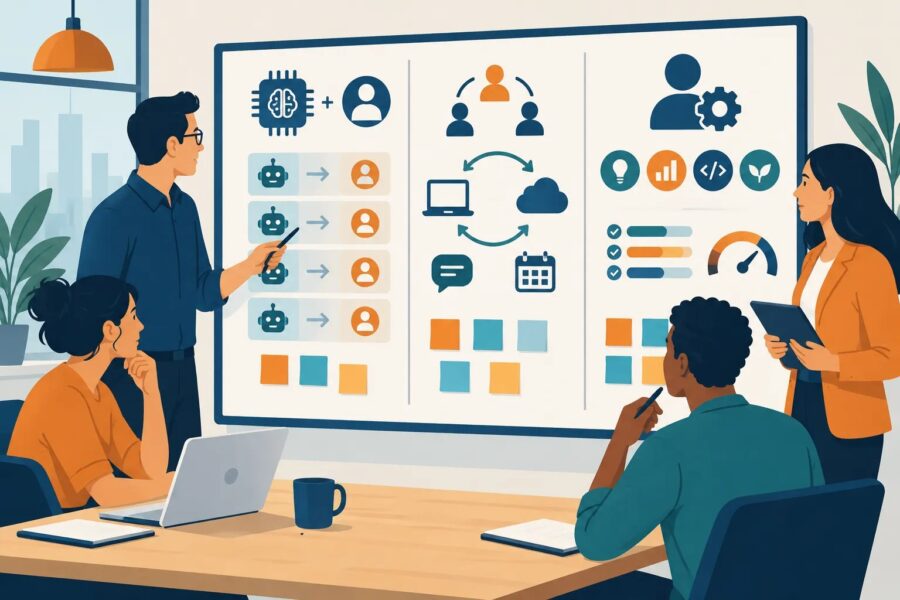
Start with the friction you can see. A team that spends hours drafting similar material may benefit from an AI pilot. A team whose decisions wait for office day needs clearer coordination.
Trend | Signal to look for | Decision to make | Measure after the change |
|---|---|---|---|
AI in daily work | Repeated manual steps or inconsistent output | Choose one workflow to redesign and name a reviewer | Cycle time, rework and errors |
Hybrid work design | Delayed decisions or meetings used as status updates | Define when teams work together and how decisions are recorded | Decision time and meeting load |
Skills-based hiring | Roles stay open while candidates are filtered by proxies | Test job-relevant work and specify required skills | Time to productive contribution and retention |
Manager pressure | Managers become approval bottlenecks | Remove low-value approvals and clarify decision rights | Escalations, team delivery and manager workload |
Employee well-being | Overtime, leave or turnover cluster in a team | Address workload and recovery in work planning | Sustainable capacity and absence patterns |
Record a baseline for your team before deciding whether a change worked. Use the signals in the table to investigate problems in each department.
AI moves from experiments into everyday work
Give employees a repeatable task with a clear output standard. A marketing team might assemble a first draft from approved source material; a support team might summarize a case before a person decides what to do. Set rules for the information staff can enter, the checks they must make, and who owns the result.
Put those rules where staff do the work. They could draft from public or approved internal material, keep customer identifiers out of unapproved tools, and have a named employee review claims before publication or customer contact. Give staff a way to flag a bad output before it spreads through a shared template.
Before buying another tool, map the inputs, handoffs, and decisions in the workflow. Include the error that would hurt a customer. Compare a limited pilot with the current process, counting corrections and rework alongside time saved.
If an automation project is on your roadmap, start by identifying tasks worth automating on an online platform before committing to another system.
Junior staff still need to learn how the work is done. When a tool produces the first pass, give new hires examples to critique and supervised decisions to make so they practice the reasoning behind it.
Hybrid work becomes a design problem
A team needs quiet time for individual work and time together for shared decisions. Decide which activities call for real-time collaboration and which can happen asynchronously, then build the schedule around them.
Agree on where decisions go and how soon a request needs an answer. Specify when a meeting is needed and how someone who cannot attend can contribute. A shared decision log and a short agenda help; managers should also notice whether remote colleagues miss stretch assignments or informal context.
Record decisions from office conversations in the channel remote staff use. Rotate visible assignments and judge the work against the role, rather than desk time.
Track missed handoffs and decision delays if coordination is slow. If focus suffers, look at interruptions and meeting time. Those problems call for different fixes.
Skills-based hiring changes how roles are defined
Describe the work a hire will do, the judgment it requires, and what success looks like in the first few months. Keep necessary qualifications. Remove credentials that serve as weak proxies for performance.
Give candidates a short, relevant work sample or the same structured interview questions. Do not ask them to complete an unpaid project. After hiring, use the skills map for development and internal moves too; otherwise, informal visibility may still decide who advances.
Connect the skills map to effective employee onboarding so new hires get practice on the tasks they were hired to perform.
Decide where to build capability and where to recruit it. If an employee can learn the task with time and support, an internal move may make better use of the budget. Hire for demonstrated experience when you need specialist judgment now.
Manager capacity becomes a constraint
Managers translate AI rules into daily work while coordinating hybrid teams, coaching new skills, and spotting workload problems. Adding those duties without removing others can turn a manager into the approval bottleneck. Training will not create more hours in the week.
“Globally, 22% of managers were engaged in 2025, down from 27% in 2024.” – Gallup, State of the Global Workplace: 2026 Report
Audit a manager’s week. Move routine approvals into documented rules; cancel meetings with no decision to make; send issues needing specialist support to HR. Then clarify who can make each decision before requesting another report.
Leave time for coaching and escalation. Ask managers to report patterns they can act on, such as repeated blocked work, rather than diagnosing employees. If deadlines keep slipping despite constant intervention, change the work or decision rights before demanding more resilience.
For recurring delivery bottlenecks, start by delegating routine communications instead of defaulting to another manager approval.
Employee well-being becomes an operational signal
When demand exceeds capacity week after week, a wellness campaign will not clear the queue. Look at overtime, unused time off, last-minute deadline changes, and who gets the urgent requests. Discuss workloads without treating anyone’s health information as a performance metric.
Limit simultaneous priorities and plan recovery after a peak period. Make it safe for staff to raise capacity issues. A manager can ask, “What work should we stop or delay?” HR can identify recurring risks across teams while protecting confidentiality.
Assess whether the team can meet commitments at a sustainable pace. Also look at service quality, retention, and planning; participation in a wellness program does not tell you whether those have improved.
A 90-day action plan for leaders
In days 1 to 30, ask team leads for a stalled workflow, a recurring handoff problem, and a capacity issue. Compare their answers with rework, delays, vacancies, or overtime already on record. Pick no more than two changes to test.
In days 31 to 60, name an owner and tell the team what will change. An AI pilot needs review and data-use rules; a hybrid team needs decision and meeting norms. In hiring, replace one weak proxy with a job-relevant assessment.
In days 61 to 90, compare quality and staff effort with the starting point. Ask managers what extra work the test created. Keep, adjust, or stop the change based on its effect on the whole workflow, then share a useful rule with other teams.
The bottom line
Prioritize AI where it cuts real work, hybrid practices where they speed decisions, and skills-based hiring where credentials are shutting out capable applicants. If managers or teams are overloaded, fix capacity first. Give each change an owner and a measurable result.
MikeGingerich.com covers the technology, HR, and operations questions behind these decisions. Use its practical business coverage to pressure-test your next change, then see whether it helps your team and customers.
FAQ
What are the key leadership trends for 2026?
Leaders need to turn AI adoption into governed workflows, make hybrid coordination explicit and protect manager capacity. The immediate task is to choose a bottleneck, assign an owner and measure whether the change improves delivery.
What are the key trends in the workforce for 2026?
AI is reshaping tasks and learning paths, while skills-based hiring puts more weight on demonstrated ability. Teams also need clearer hybrid working norms and realistic workloads to sustain performance.
What are the key trends in workplace wellbeing for 2026?
Employers are treating workload, recovery and manager support as part of how work is designed, not only as benefits. Watch for persistent overtime and overloaded handoffs, then change priorities and capacity rather than relying on a program alone.
What are the new trends in the workplace?
The practical shifts are AI in everyday processes, hybrid work rules built around tasks, hiring for demonstrated skills and closer attention to manager and employee capacity. Which one matters most depends on where your team is losing time or quality now.