Anthropic’s Claude Code Loses Developers to OpenAI Codex

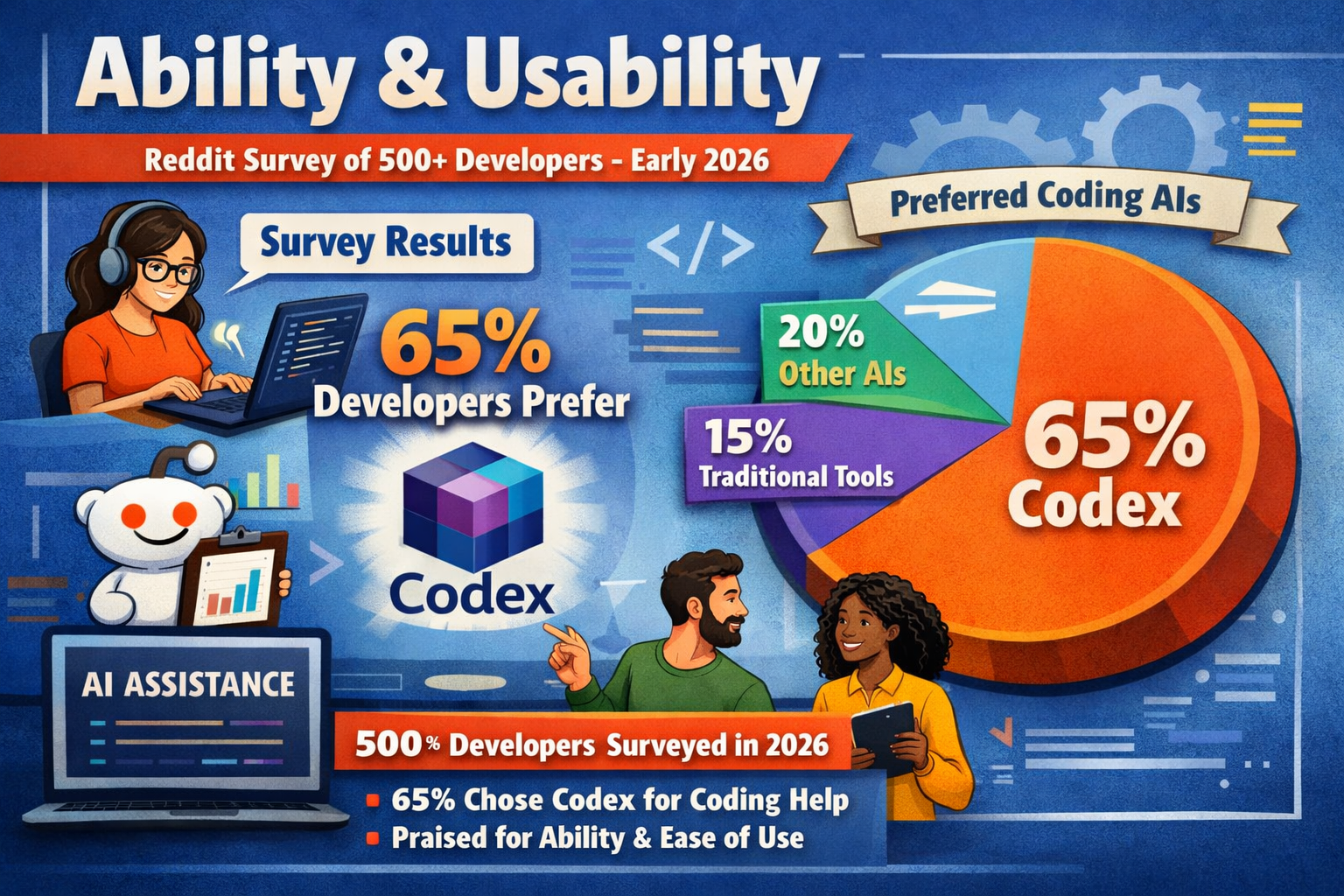
Anthropic’s Claude Code is facing a significant developer backlash in May 2026, as users increasingly abandon the platform in favor of OpenAI’s Codex amid growing concerns about reliability and usability. A Reddit survey of 500+ developers in early 2026 showed 65% preferring Codex to 35% Claude Code on raw preference, marking a dramatic shift in the AI coding tools landscape.
The exodus appears to be driven primarily by rate limiting issues and token efficiency concerns that make Claude Code difficult to use for extended development sessions. Despite Claude Code’s superior technical capabilities on paper, developers report that the tool’s usage restrictions create workflow interruptions that undermine its practical value.
The Core Issue: Quality Versus Usability
Claude Code has better code quality (67% win rate in blind tests) but hits usage limits too quickly to be a daily driver. Codex is slightly lower quality but actually usable, according to analysis of developer feedback. This fundamental tension has become the defining characteristic of the 2026 AI coding agent competition.
Codex uses roughly 4x fewer tokens than Claude Code for equivalent tasks. On a real-world Express.js refactoring test, Claude Code used 6.2 million tokens. Codex did the same work with 1.5 million. For developers paying per token or working within subscription limits, this efficiency gap translates directly into usable hours of coding assistance.
Market Dynamics and User Migration
Between September 2025 and January 2026, OpenAI’s Codex went from around 5% of Claude Code’s usage to roughly 40%. By March, Codex had over 2 million weekly active users. More recent data suggests this trend has accelerated, with Codex recently surpassed 3 million weekly active users, up from 2 million just a month earlier.
OpenAI specifically launched a new $100/month tier earlier this month targeting exactly this pain point, developers hitting Codex and Claude Code limits. The fact that they named both tools in their announcement tells you everything. They’re poaching Claude Code users who are tired of rate limiting.
Technical Strengths Remain
Despite the user defections, Claude Code maintains significant technical advantages in specific areas. The April 2026 Opus 4.7 release jumped SWE-bench Verified from 80.8% to 87.6% in a single version bump, with SWE-bench Pro moving from 53.4% to 64.3%. The platform continues to lead in code quality benchmarks and complex reasoning tasks.
Claude Code has mature computer use capabilities. It can do this in a single agentic loop without handing off to a separate automation tool, giving it an edge for workflows that extend beyond pure code editing to include browser interactions and external tool integration.
The Dual-Tool Solution
Rather than choosing one platform exclusively, experienced developers are increasingly adopting a hybrid approach. The most productive developers are already using both, according to community analysis. This pattern involves using Claude Code for high-stakes work like authentication and payment processing, while delegating routine tasks to Codex.
A pattern that works: Claude Code for planning and architectural diffs, Codex for tightly scoped follow-ups. They commit to the same branch, you read the PR. This workflow allows developers to leverage Claude Code’s superior reasoning for critical decisions while avoiding its usage limitations for repetitive work.
Pricing and Value Considerations
Both platforms offer $20 monthly entry tiers, but their value propositions differ significantly at this price point. At the $20 tier, this means Codex gives you more actual usage before hitting limits. Casual to moderate use (a few hours a day, standard coding tasks): Codex at $20 is the better deal. More usable volume, fewer interruptions, no pressure to upgrade.
For power users, the calculation becomes more complex. Claude Code offers a $100 mid-tier option, while both platforms have $200 professional tiers with substantially higher usage limits. Code quality is genuinely close in 2026. Both will write solid code, both will miss edge cases, both will occasionally surprise you in good ways and bad.
Developer Sentiment and Trust
The narrative around Claude Code’s rise has shifted from technical superiority to questions about practical usability. A $20 plan that runs out after 12 prompts isn’t your daily driver, no matter how good the quality. Codex might be slightly lower quality, but it lets developers code without interruption. That difference is moving the community right now.
A survey by the Pragmatic Engineer of 906 software engineers in February 2026 found it was the most-loved AI coding tool with a 46% “most loved” rating, suggesting that despite current challenges, Claude Code retains strong support among certain developer segments who prioritize its unique capabilities.
Key Facts
- 65% of surveyed developers prefer Codex over Claude Code as of early 2026, up from minority usage six months prior
- Claude Code maintains a 67% win rate in blind code quality tests despite losing market share
- Codex uses approximately 4x fewer tokens than Claude Code for equivalent tasks
- Codex reached 3 million weekly active users in May 2026, up from 2 million in April
- OpenAI launched a $100/month tier specifically targeting developers frustrated with rate limits
- Claude Code’s Opus 4.7 model achieved 87.6% on SWE-bench Verified in April 2026
Sources
- BigGo Finance: Claude Code Faces Crisis of Trust
- The Ultimate Battle: Claude.ai Web vs. Claude Code
- XDA Developers: I started using Claude Design
- Medium: Developers Switch from Claude Code to OpenAI Codex
Sources
- Developers Switch from Claude Code to OpenAI Codex Amid Reliability Issues | by tamimbuilds | Apr, 2026 | Medium
- Claude Code vs Codex 2026 — What 500+ Reddit Developers Really Think – DEV Community
- Cursor, Claude Code, and Codex are merging into one AI coding stack nobody planned – The New Stack
- Claude Code vs Codex: The 2026 Comparison – CatDoes
- Codex vs Claude Code: Which AI Coding Agent Should You Use in 2026? | MindStudio
- Codex vs Claude Code in April 2026: Which Agent for Which Job – Developers Digest
- Codex vs Claude Code in 2026: Which Actually Saves You Money? – Hongkiat