Open-source alternatives challenge Claude Code

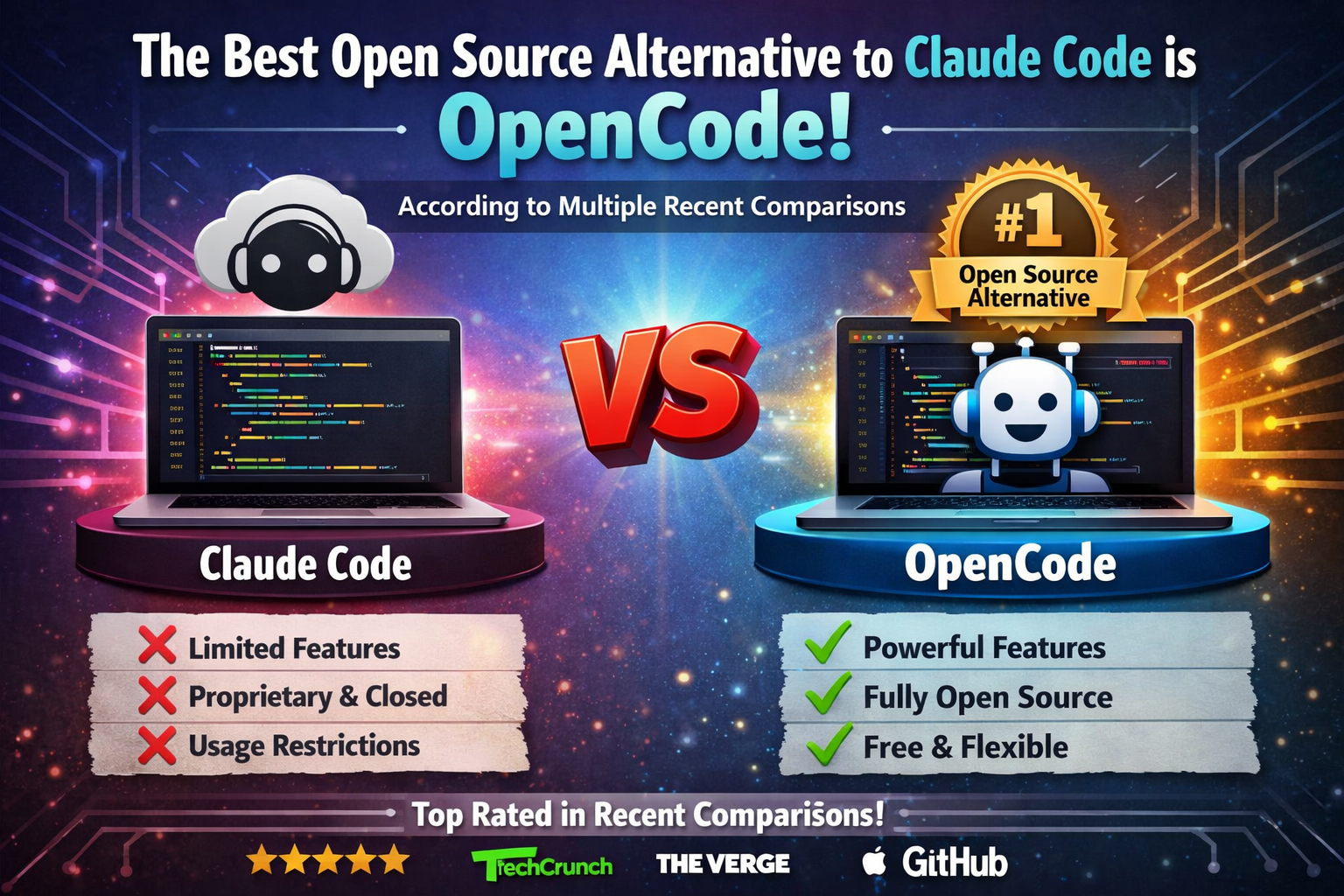
The rise of AI coding assistants has created a new competitive landscape, with developers increasingly turning to open-source alternatives that promise similar capabilities to commercial tools like Claude Code without the vendor lock-in or recurring costs. The best open source alternative to Claude Code is OpenCode, according to multiple recent comparisons, alongside tools like Aider, Cline, and OpenHands that have gained substantial traction in 2026.
As Claude Code with Opus 4.7 scores 87.6% on SWE-bench Verified, a key benchmark for AI coding performance, open-source projects have rushed to close the gap. The motivation is clear: its usage limits and $20/mo model lock-in still push developers to look elsewhere. Recent developer discussions reveal frustration with Claude Code’s cost structure, with a developer on Hacker News posting that their Claude Code session burned through $47 in a single afternoon of refactoring. The thread blew up. Not because the number was surprising. Most heavy Claude Code users have war stories like this. It blew up because of how many developers replied saying they’d already switched to open-source Claude Code alternatives and hadn’t looked back.
Leading Open-Source Contenders
The top alternatives to Claude Code in 2026 are Aider, OpenHands, and Cline. The best open-source Claude Code alternative depends on your workflow: Aider is the closest terminal-based equivalent with over 42,000 GitHub stars, OpenHands offers full autonomous agent capabilities in a sandboxed Docker environment, and Cline integrates natively into VS Code with human approval at every step. All three share a critical advantage: All three are model-agnostic, meaning you can swap AI providers freely instead of being locked to Anthropic.
Cline offers every step as approvable, or you can enable auto-approve for unattended runs. Model choice is unrestricted. Claude, GPT, Gemini, local Ollama or LM Studio instances, and any OpenAI-compatible endpoint all work. You bring your own key or your own weights. The tool has achieved remarkable reach, with Cline being the most popular open-source AI coding extension with 5M+ installs across VS Code, Cursor, JetBrains, Zed, and Neovim.
OpenCode’s Growing Momentum
OpenCode has emerged as particularly noteworthy among open-source options. OpenCode currently has 90.4k GitHub stars, ranking it among the most-followed developer tools in this category. That level of attention reflects steady adoption across individual developers and teams. The project’s appeal centers on flexibility: It connects to 75+ LLM providers through Models.dev, including local models, and supports Claude, GPT, Gemini, and others.
A distinctive feature sets OpenCode apart from competitors: Developers with existing GitHub Copilot or ChatGPT Plus/Pro subscriptions can log in directly and use those accounts without paying for another service. This “subscription piggybacking” approach, as some developers call it, can eliminate incremental costs for teams already paying for other AI services.
Cost Savings and Model Flexibility
The economic argument for switching has resonated widely. Developers testing Aider, OpenHands, and Cline report cutting AI coding costs 60%. Cline’s v3.2 update added automatic model routing that picks the cheapest model per task, bringing typical monthly API costs to $8-12, a significant reduction compared to Claude Code’s fixed subscription pricing.
Beyond cost, model flexibility offers practical advantages. Aider maintains its own polyglot coding benchmark across 225 Exercism exercises in six languages including Python, JavaScript, and Rust. In 2026, GPT-5 in high-reasoning mode scores 88% correctness on this benchmark while Claude Sonnet 4 scores competitively. The key advantage is that Aider lets you chase whichever model performs best at any moment rather than being locked to one provider.
The Broader Ecosystem
OpenHands (formerly OpenDevin) is an open-source autonomous AI development agent with over 70,000 GitHub stars that goes beyond simple code edits by browsing documentation, running shell commands, executing tests, and debugging failures inside a sandboxed Docker container. It uses a planning-execution loop where the agent breaks down tasks, observes results, and adjusts, making it closer to a fully autonomous coding agent than a traditional AI pair programmer.
The commercial landscape continues to evolve alongside these open-source options. Cursor hit $2B ARR in February 2026 (up from $1B in November 2025), is raising at a $50B valuation, and has 70% of the Fortune 1000 as customers, demonstrating sustained demand for AI coding tools despite the emergence of free alternatives.
Key Facts
- Claude Code with Opus 4.7 scores 87.6% on SWE-bench Verified, up from 80.8% on the previous version
- OpenCode currently has 90.4k GitHub stars as of early 2026
- Cline is the most popular open-source AI coding extension with 5M+ installs
- Cline’s automatic model routing brings typical monthly API costs to $8-12
- OpenHands has over 70,000 GitHub stars
- Cursor hit $2B ARR in February 2026
Sources
- XDA Developers: These open-source tools do what Claude charges for
- Anthropic: When AI builds itself
- 3 Open-Source Claude Code Alternatives [2026 Compared]
- 10+ Best Open Source Claude Code Alternatives in 2026